This article contains affiliate links. As an Amazon Associate I earn from qualifying purchases.
Most of us plan to teach our kids about money at some vague future point when they have some.
By then it's a correction, not a lesson. A sixteen year old with a paycheck already has a whole set of instincts about spending, and those instincts got built somewhere, probably by watching us and by never once having to decide between two things they wanted.
The window that actually matters opens around four and closes quietly around twelve. Not because a teenager can't learn, but because everything after twelve is refinement of habits that already exist.
This article is about the years before the paycheck.
Money Has to Be Physical First
A young kid cannot learn anything from a number on a screen.
Everything we do is invisible now. A card taps, food appears. To a five year old that isn't a transaction, it's a magic trick, and the lesson they absorb is that money is infinite and slightly boring.
So the first job is making it real, and that means cash, in a hand, that runs out.
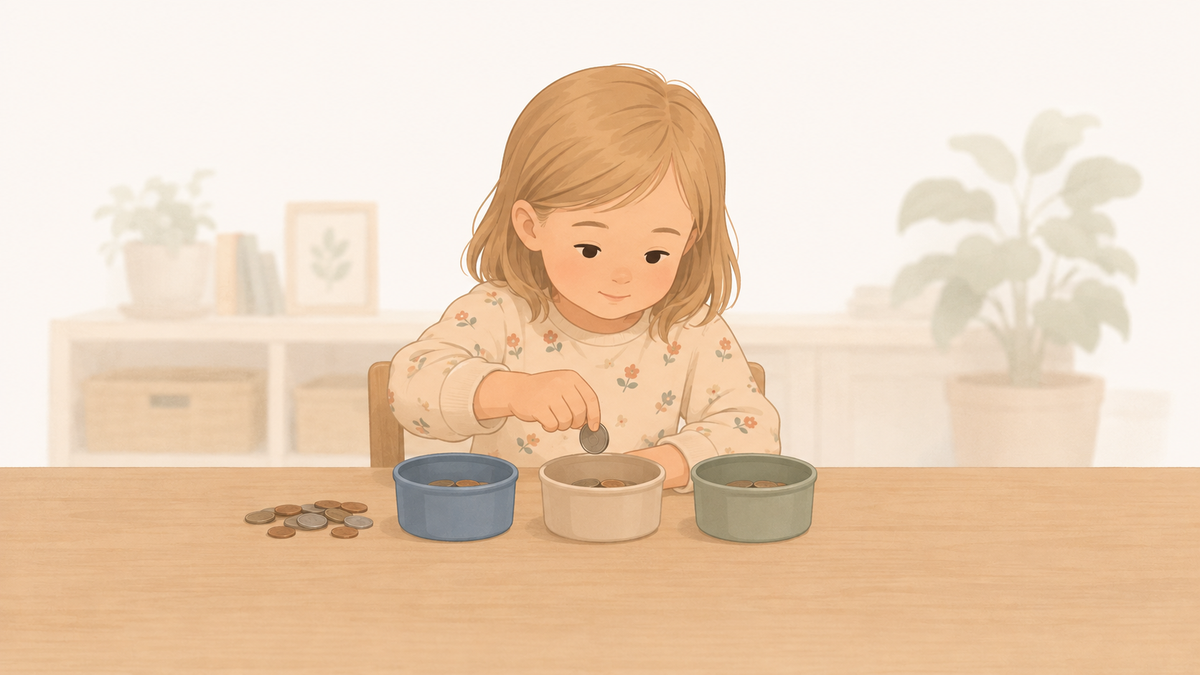
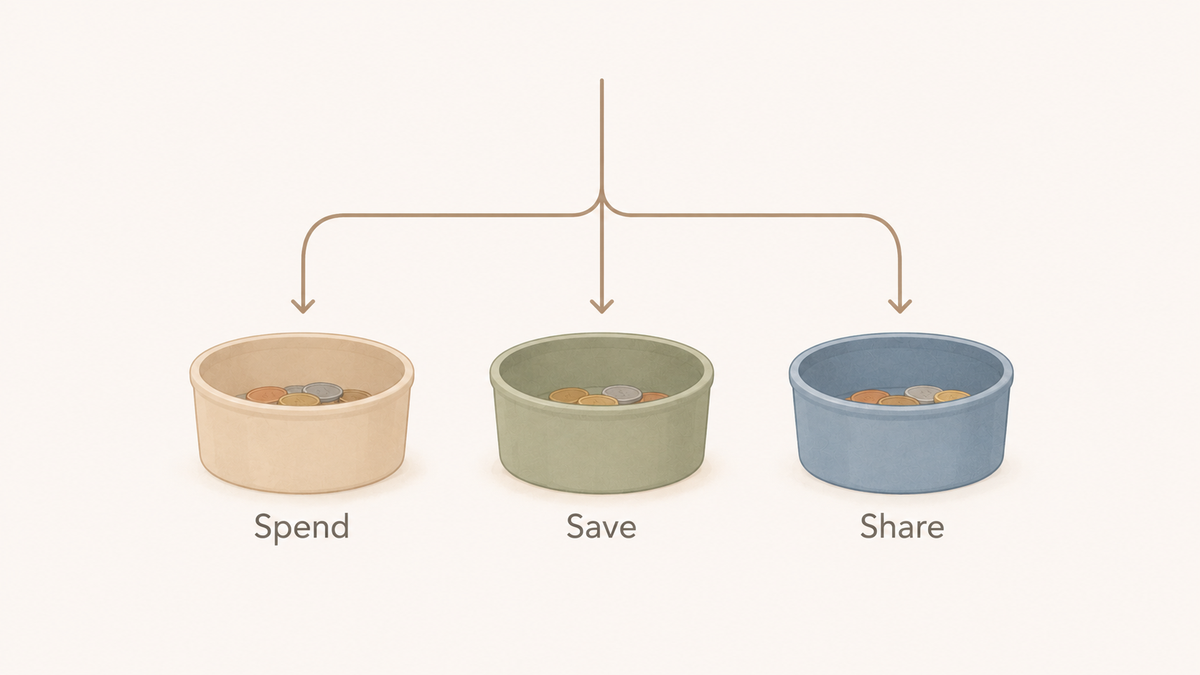
Three containers, not one. A single piggy bank teaches accumulation, which is one third of the skill. Three teaches allocation, which is the actual skill: money is finite and it goes somewhere on purpose.
Label them spend, save, share. Every time money comes in, it gets split before anything else happens. The splitting is the lesson and it takes about eleven seconds.
A Moonjar three-part bank does this with three attached compartments, which matters more than it sounds like it should. Three separate jars end up in three separate places and the system quietly dies. Three mason jars taped together works exactly as well if you'd rather not buy anything.
Let them physically pay sometimes. Hand them the cash at the register and let them do the whole exchange, including waiting for change and counting it. The moment where they hand over money and it's gone is the entire lesson, and it does not survive translation to a card.
The Allowance Question
Two positions, both defensible.
Allowance tied to chores: money is earned, work produces income, and there's a direct line between effort and reward.
Allowance not tied to chores: chores are what it costs to live in a house with other people, and money is a separate skill that needs practice material. Pay for the practice, not for basic decency.
What we do, and what I'd recommend: a small unconditional allowance so there's something to practice with, plus a short list of genuinely optional paid jobs on top. Nobody gets paid for clearing their own plate. Washing the car is payable.
The reason to split it that way is that if all money is earned through chores, a kid who doesn't want anything this month simply opts out, and the money lessons stop with them. You need a baseline flow of money for the same reason a piano needs to stay in the house.
On amount: a common rule is a dollar per year of age per week, which is fine and arbitrary. What matters much more is that the amount is small enough that mistakes are cheap and large enough that the choices are real. If they can buy anything they want, they never have to choose, and choosing is the skill.
Pay on a schedule and never early. The waiting is doing real work. An advance teaches that the timeline is negotiable, which is exactly the belief you don't want them carrying into a credit card at nineteen.
The chore side of this is its own thing: what kids can actually handle at each age.
Money Skills by Age
Ages 3 to 5
- Recognize coins and bills as different amounts
- Understand that money runs out
- Hand cash to a cashier and take the change
- Split incoming money into spend, save, share
- Wait a week for something small
Ages 6 to 8
- Add and count their own money accurately
- Compare two prices and say which is more
- Save for a specific named thing across several weeks
- Make a real choice between two things they want
- Notice that the same item costs different amounts in different places
Ages 9 to 12
- Compare by price per unit, not just by price
- Keep a simple written record of what came in and what went out
- Plan a small purchase in advance instead of deciding in the store
- Understand that a store wants them to buy, and recognize a few of the ways it asks
- Earn money from something outside the house: a neighbor, a small job, selling something
- Understand what borrowing means, and that it costs extra
That last one only needs to be a sentence at this age. Borrowing means you pay back more than you took. They don't need the mechanics yet, they need the shape of it, so the word doesn't sound free to them later.
Let Them Buy the Bad Thing
This is the hardest part and it's most of the value.
Your kid is going to want to spend eleven dollars on something that will be broken or forgotten by Thursday. You will be able to see the whole future clearly. You will want to redirect them toward something better.
Don't.
The point of giving a kid money is giving them the chance to be wrong about it while the amount is eleven dollars. The disappointment is the curriculum. A kid who buys the junk toy, plays with it twice, and then realizes they can't afford the thing they actually wanted has learned something permanent, in about a week, for eleven dollars.
You can say one sentence. "Are you sure? That's most of your spend jar." Then let it go, buy the thing, and do not say anything at all afterward when it breaks. Not a word. The lesson dies the second it becomes something you were right about.
This is the right size of struggle: real consequence, small cost, fully recoverable.
Four Things Not to Do
Don't make money a secret. Kids who never hear money discussed don't grow up neutral about it, they grow up anxious about it. You don't have to disclose your salary. You can absolutely say "that's not in the budget this month" out loud and let it be an ordinary sentence.
Don't use money as the reward for everything. Grades, behavior, kindness. Paying for those teaches that the reason to do them is external, and then you have to keep paying forever.
Don't rescue every shortfall. If they spent it, they spent it. Covering the gap is the money version of doing everything for them, and it teaches that running out is a temporary state that gets fixed by an adult.
Don't lecture at the register. Nobody has ever learned anything about money while being embarrassed in a store. Have the conversation later, at home, when neither of you is holding a shopping cart.
If You Want to Go Deeper
Make Your Kid a Money Genius (Even If You're Not) by Beth Kobliner is the one I'd point a parent to. It's organized by age, it's specific about what to say, and it's written for parents who don't feel qualified to teach this, which is most of us. The title is worse than the book.
What Comes After This
Everything above is the foundation. It runs out somewhere around thirteen, when the money stops being symbolic and starts being real.
The next layer is a different set of skills entirely, and it needs its own runway:
- A first job, and what a paycheck actually looks like after the deductions
- A real bank account they operate themselves
- A budget for money that arrives irregularly
- Credit, which is the one where the mistakes get expensive and permanent
- The first big purchase, usually a car
- Saving for something more than a month away
None of those work as a lecture either. They work the same way the jars worked, by handing over a real thing with a real consequence and staying out of it. If the foundation is in place, that handoff is much less dramatic than it sounds. The broader list of what to hand over before they leave home covers where this fits with everything else.
For now, three jars and eleven dollars they're allowed to waste.
Teach Your Kid Almost Anything is a free starter framework for raising a capable kid. A simple five-step method that works on almost any skill, plus a competence inventory to work through over the years. Download it free →
The method here is the same as everything else. Name one skill, show it once, let them do it badly, describe what happened, step back.
The only difference with money is that the bad version costs actual dollars, and you have to decide that eleven of them is a reasonable price for a lesson they'll otherwise learn at twenty two with a credit card.