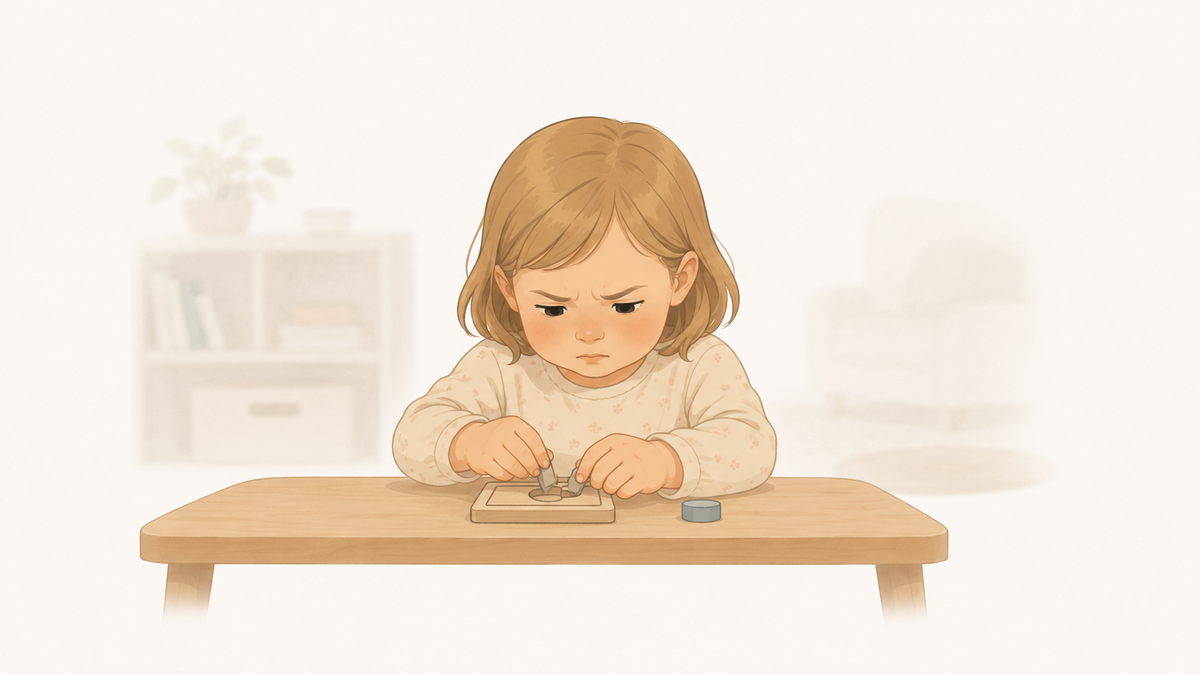
There is a sound a kid makes when something is hard.
It is not crying and it is not asking for help. It's somewhere underneath both of those. A short noise of pure frustration, aimed at an object.
Every instinct I have says to walk toward that sound.
Last night it was the living room.
She had been in there for an hour being every character in an episode of Mickey Mouse Clubhouse, using Jurassic Park Little People, and the floor showed it. Before bed she has to clean it up. Usually I help.
Her mom was washing dishes. I was giving her baby sister a bath. So she came and asked her mom, and then she came and asked me, and then she went back, and then she came back. Five times, roughly. We both told her the same thing, which was yes but not right now, you'll have to start without us.
Around the fifth trip into the bathroom I gave her one thing and not the answer: start with the ponies, you know where those go. She kind of sort of did it.
Then her mom finished the dishes and I heard her say, well, now you have to clean this up by yourself. A minute later I heard the clean up song, and a two year old running back and forth putting toys in mostly the right places.
She cleaned the whole room. Then she kept going, and got so detailed about it that I had to come out and tell her that what she'd already done was more than we asked for.
That's a different version of the sound. Hers wasn't a noise, it was five trips down the hallway looking for somebody who would do it with her. Same thing underneath.
The Two Kinds of Frustration
Not all of it is the same, and the difference is the entire skill.
There's the frustration of a problem that's the right size. The kid is stuck but the answer is inside the room. They have what they need, they just haven't found the order yet. This one looks miserable and is completely productive.
Then there's the frustration of a problem that's the wrong size. Missing information, missing tool, missing strength. No amount of persistence gets there, and every minute spent teaches that trying doesn't work.
Same noise. Opposite meanings.
I don't think there's a reliable way to tell from the outside, which is inconvenient. What I've settled on is watching whether they're still generating new attempts. A kid who is trying different things is working. A kid who is trying the same thing harder and louder has hit a wall, and that's the moment to add exactly one piece of information and step back out.
One piece. Not the answer.
What I Actually Do With Myself
The hard part isn't judging the situation. It's the ninety seconds.
I don't do anything with my hands. There's no trick, no counting, no leaving the room.
What I do is say one sentence to myself: this is good for her, unless it's dangerous. That's the entire method. I say it several times a day and it works about as often as it doesn't.
The urge to step in isn't patience failing. Patience implies calm waiting. This is closer to standing still while something in you files a complaint.
What helps me is remembering that the discomfort is mine, and outsourcing it to them by taking over is a bad trade I'm making to feel better.
The Thing You're Protecting
When I take over, I'm not stealing the task. The task is nothing. It's a shoelace or a jar or a math problem.
What I'm stealing is the moment right after.
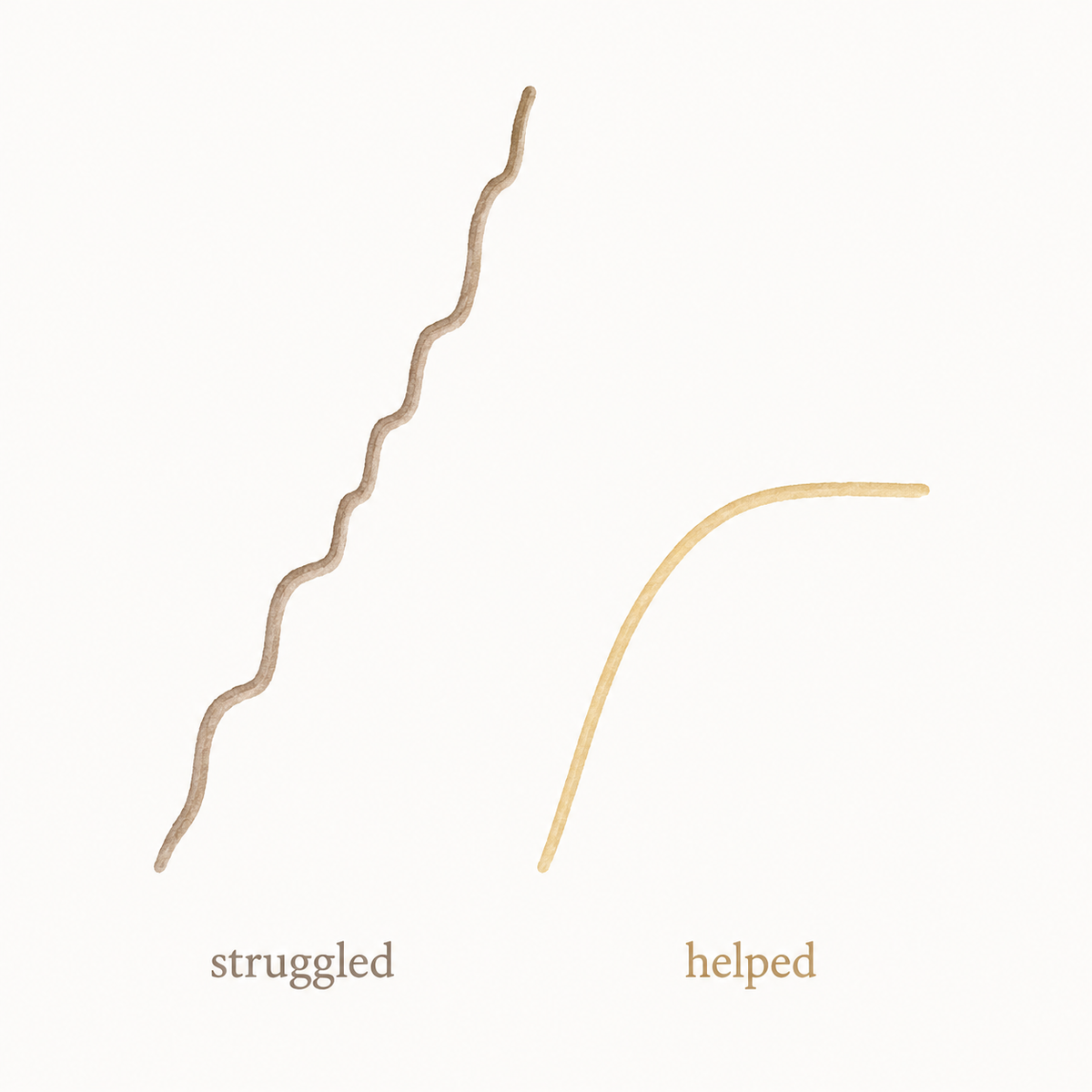
Because the thing a kid gets from finishing something hard on their own is not the shoelace. It's a small piece of evidence, filed away somewhere, that hard things can be gotten through. They can't be told that. There is no version of saying it that installs it. It only arrives attached to something they actually did.
And it compounds. A kid with a hundred of those is a different person from a kid with four, and the difference doesn't show up as confidence. It shows up as a kid who doesn't look up at you when something goes wrong.
That's the whole thing I'm trying to build. Competence is quiet and so is this. You never get the moment where it lands.
Where I Get It Wrong
I don't have one story for this, because it isn't one incident. It's a direction I lean, and it's the opposite of everything above.
I jump in too early. I notice afterward, usually while I'm already holding whatever it was. It isn't that I don't want them trying things on their own, and most of the time the thing they're doing wrong costs nobody anything. I just have an aggressive need to do things for my girls, because I love them, and that need does not stop to check whether it's useful first.
Still working on it.
There's also the version where I'm not being principled at all. I'm just tired, or on a call, and the not-helping is convenient. I'd like to say I can always tell the difference from the inside. I can't, always.
The Rule I Try to Hold
Step in for danger and for damage. Nothing else.
A hot pan going the wrong way, a knife moving toward a hand, something about to break that can't be replaced. Those are real.
A mess is not danger. A wasted ingredient is not damage. Being late to something that doesn't matter much is not either one, and letting that consequence land is often the cheapest teaching available all week.
Everything I know about this fits into the five-step method at step three, which is the one where you hand it over and let them be bad at it. That's the step everybody skips. This whole article is really just an argument for not skipping it, and most of what we do for our kids is a version of skipping it.
Try This
1. Wait ninety seconds. Longer than you think. Most struggle resolves itself inside a window shorter than the one you're comfortable with.
2. Give one piece, not the answer. "The pan's too hot" beats taking the pan. Then get back out.
3. Ask what they noticed. After, not during. It builds the muscle that lets them do this without you next time.
4. Say the true thing when it works. Not "good job." Something like "that was hard and you stayed with it," which describes what happened instead of grading it.
Teach Your Kid Almost Anything is a free starter framework for raising a capable kid. A simple five-step method that works on almost any skill, plus a competence inventory to work through over the years. Download it free →
I still walk toward the sound. Every time.
I've just gotten slightly better at stopping in the doorway, and at understanding that the noise a kid makes when something is hard is usually not a call for help. It's just the sound of the thing working.