This article contains affiliate links. As an Amazon Associate I earn from qualifying purchases.
I don't remember what age I was when chores got assigned. I remember that before that, I was already responsible for cleaning up after myself. My plate, my room, anything I touched. The standard in that house was leave it in the same condition or better.
The assigned list, over the years: pull weeds, mow the lawn, scrub the pool, pick up dog poop, walk the dogs, get the mail, clean the bathroom, wash the cars, rake the leaves, sweep the rocks back in with the other rocks.
My work was always checked. If it wasn't right, I did it again. And again.
The worst was leaves. Miss one or two and a parent would take the bag I had just filled and empty it back across the yard.
Years later, in basic training, I raked an entire field. My drill sergeant looked at it and said great job, now dump it out and spread them evenly along the field. Different purpose, allegedly. Same afternoon.
I am not recommending the leaves thing. But almost everything I know about doing a job properly, I learned from chores, and none of it came from anybody explaining anything to me. Nobody taught me to fix a car or cook a meal. Somebody did make me redo a bathroom.
Before the List
Two things worth saying, because most chore lists skip both.
This is a list of what kids are capable of, not a list of what you should expect tonight. No two kids are the same. My toddler does things that aren't supposed to be on her list yet, and some weeks she does more around the house than the teenager does. Take the bands as a rough map of what's physically and mentally possible, not as a report card.
Every chore gives something back, and it's usually not the clean floor. A chore is a skill they're learning. The house getting cleaner is a side effect. That distinction changes how you assign them, how you react when they're done badly, and whether you pay for them. So each age below says what the kid actually gets out of it, which is the part that makes it worth the hassle.
The Short Version
If you want the whole thing at a glance:
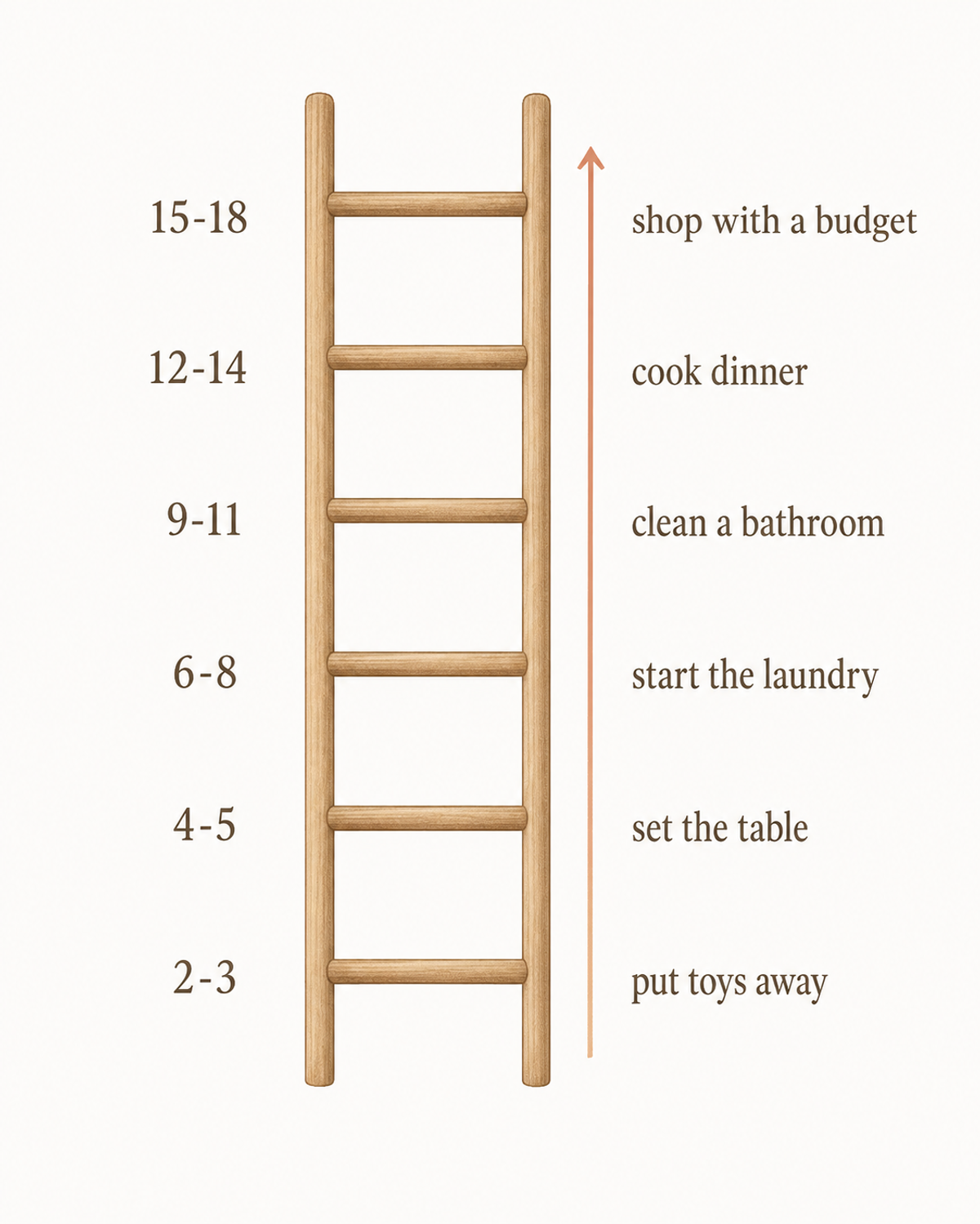
- Ages 2 to 3: put toys away, throw trash away, wipe up spills, carry their plate to the sink, put dirty clothes in the hamper
- Ages 4 to 5: make their bed roughly, feed a pet, set the table, match socks, water plants, dust low surfaces
- Ages 6 to 8: sort and start laundry, load and unload the dishwasher, take out trash, sweep, make a simple breakfast, pack their own school bag
- Ages 9 to 11: run a full load of laundry start to folded, clean a bathroom, vacuum the house, take the bins to the curb, cook one simple meal, basic yard work
- Ages 12 to 14: cook dinner for the family once a week, change bedsheets, clean the kitchen after a meal, manage their own laundry entirely, watch a younger sibling briefly
- Ages 15 to 18: grocery shop from a list with a budget, plan and cook multiple meals, deep clean a room, basic car care, manage their own schedule and deadlines
Now the version with the details that actually matter.
Ages 2 to 3: The Copying Years
At two, a kid wants to do what you're doing more than they'll ever want to again. This is the cheapest window you will ever get and most of us waste it, because the help is not help.
What they can do:
- Put toys in a bin
- Throw something in the trash
- Wipe up a spill with a cloth
- Carry their plate to the sink
- Put dirty clothes in the hamper
- Hand you things while you work
What it gives them: the belief that work is normal and that they're the kind of person who does it. Nothing about sweeping. At this age you are installing a self concept, and it goes in before there's any opinion attached to it.
What to expect: the toys go in the bin and then come back out. The wiping moves the spill around. None of that is the point.
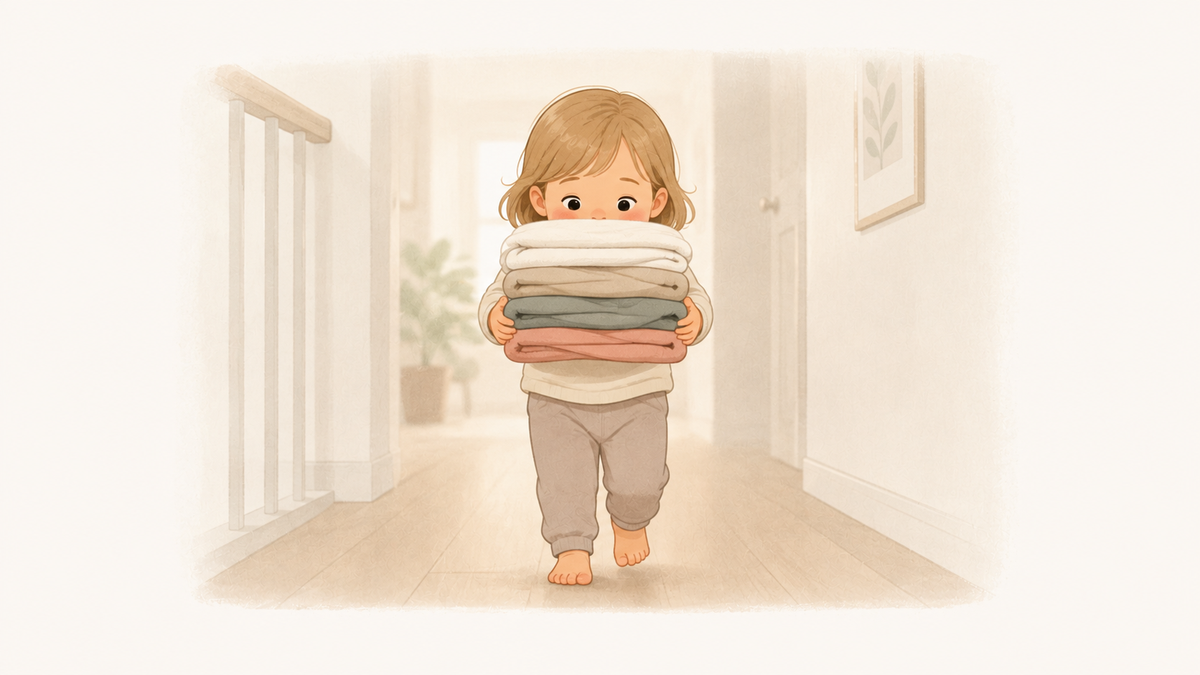
Mine got there by copying. I would start picking up the living room while she was still playing in it, and at some point, without either of us deciding anything, she started picking up too. Now she cleans up her toys most nights. I prompt her less every month.
A kid size cleaning set is one of the few kid versions of a tool that earns its place. A full size broom is genuinely unusable at this height, and a kid who can't operate the tool just watches you operate it.
The one rule for this age: never redo it in front of them. If the job needs fixing, fix it later. A two year old who watches you undo their work learns the actual lesson, which is that their work doesn't count.
Ages 4 to 5: The First Real Ownership
Now they can hold a job that belongs to them, all week, with a name.
What they can do:
- Make their bed, badly
- Feed a pet on a schedule
- Set the table
- Match socks
- Water plants
- Dust low surfaces
- Clear their own dishes
What it gives them: the first experience of something being theirs. Not borrowed, not supervised. Ownership is a different feeling from obedience and this is the age it becomes available.
The bed thing. A four year old's made bed looks like a made bed from across the room and terrible from up close. Leave it. The habit is the objective and the technique arrives on its own over about two years. If you straighten it after they leave, you've taught them that the standard is unreachable and the job is really yours.
Feeding a pet is the best chore at this age because the consequence is visible and it isn't you. The dog is hungry or the dog isn't. Nobody has to nag about it.
Ages 6 to 8: The Multi-Step Years
Somewhere in here a kid becomes able to hold a sequence in their head. That unlocks most of the useful chores.
What they can do:
- Sort laundry and start the machine
- Load and unload the dishwasher
- Take out the trash
- Sweep a floor
- Wipe counters and the table
- Make a simple breakfast
- Pack their own school bag
- Put their own laundry away
What it gives them: the ability to hold a multi step job without a person standing next to them narrating it. That's the same muscle as homework, as a recipe, as instructions of any kind.
Make a real thing, not a pretend thing. A six year old cracking eggs into a real breakfast is learning something. A six year old "helping" with a task that would happen identically without them is learning to perform helpfulness. There's a real difference, and kids can tell which one they're doing. This is the age where letting them actually cook something starts paying off.
Packing their own bag is the sleeper item on this list. It's the first chore that's about managing themselves rather than managing the house, and it's the direct ancestor of every deadline they'll ever have to hit.
Ages 9 to 11: Whole Jobs, Start to Finish
The shift here is from tasks to jobs. A task is "put the clothes in the dryer." A job is "the laundry is done."
What they can do:
- Run a full load of laundry, start to folded and put away
- Clean a bathroom properly
- Vacuum the house
- Take the bins to the curb on the right night
- Cook one simple meal with supervision nearby
- Rake, water, pull weeds
- Wash a car
- Change their own sheets
What it gives them: ownership of an outcome instead of a task. That's the difference between an employee who does what they're told and one you can hand something to and stop thinking about.
"On the right night" is the skill, not the bin carrying. Remembering the day without being told is a genuinely hard thing that a lot of adults never get good at. Let them forget once and have the bins sit full for a week. That week teaches it.
Whole jobs need a definition of done. Write it once. "The bathroom is clean" means the mirror, the sink, the toilet, the floor. Otherwise every inspection turns into an argument about what you meant, and you both lose.
Ages 12 to 14: Contributing Adult, Junior Version
This is the age where a kid can carry something the household actually depends on. Which means it's also the age where they find out that being depended on feels different from being assigned.
What they can do:
- Cook dinner for the family once a week, from planning to cleanup
- Manage their own laundry entirely, no reminders
- Clean the kitchen after a meal
- Change bedsheets
- Watch a younger sibling for a short stretch
- Basic home maintenance: change a lightbulb, reset a breaker, unclog a drain
- Mow the lawn
What it gives them: the experience of being genuinely needed by other people. Not praised. Needed. Those land differently and only one of them builds anything.
One dinner a week is the highest leverage chore on this entire page. It's planning, timing, shopping awareness, cleanup, and a real deadline, all in one job, with immediate feedback from people who are hungry. If you assign one thing at this age, assign this.
Stop reminding. Twelve is late for this and most of us are still doing it. A chore you have to remember on their behalf isn't theirs yet, it's yours with extra steps. Reliable people win, and reliability is not a personality trait. It's a thing that gets built in exactly this window, by being allowed to drop a ball that matters slightly.
Ages 15 to 18: Practice Being On Their Own
Everything from here is rehearsal for a household they run themselves, and the clock is visible now.
What they can do:
- Grocery shop from a list, with a budget, and come back with the right things
- Plan and cook multiple meals
- Deep clean a room or a space
- Basic car care: fuel, tire pressure, checking the oil
- Handle their own appointments and phone calls
- Manage their own calendar and deadlines
- Yard and home upkeep without direction
What it gives them: the evidence that they can run a life. Not the belief, the evidence. There's a version of eighteen where a kid is confident and has never actually done any of it, and that version does not survive contact with a first apartment.
Hand over the whole system, not more tasks. "You handle groceries for the week" is a better assignment at sixteen than five individual chores, because the thing they're short on isn't labor. It's practice making the small decisions inside a job nobody is supervising.
A fair warning about this band. It is the one where the gap between capable and willing is widest, and where you'll be most tempted to read that gap as a character problem. It usually isn't. A fifteen year old has a schedule now, and opinions, and somewhere else they'd rather be. The list above is still what they can do. Getting there is a negotiation in a way that it wasn't at six.
If you want the full inventory for this age, it's here: the life skills worth teaching before they leave home.
Making It Visible
Kids under about ten do dramatically better with a chore they can see than a chore they were told about on Sunday.
Visible means on a wall, in a place they walk past, in a format they can update themselves. The updating is the part that matters. A chart only you touch is a to-do list you're keeping for them, which puts the job back on your side of the line.
We run a star system for the toddler. She loves it and she does not understand it even slightly. She checks off her tasks every day with complete commitment and has never once asked what the stars are actually for. Right now the reward is the checking, and I am in no rush to explain the exchange rate to her.
A Melissa & Doug responsibility chart does this well for the four to eight range, mostly because moving the piece is satisfying enough that they'll do it without being asked. Whatever you use, the requirement is the same: they operate it, not you.
For older kids, drop the chart entirely and use a shared calendar or a note on the fridge. A teenager with a magnet chart will not engage with it, and I don't blame them.
How to Hand a Chore Over So It Stays Handed Over
Assigning is not the same as teaching. Most chore systems fail on this, not on the list.
Run the five-step method on any chore you're adding: name it, show it once, let them do it badly, describe what happened instead of grading it, then remind them of one fewer thing each round until you're out of the loop.
Then three rules that keep it handed over.
Define done, once. In writing if the job has more than three parts. It ends the arguing.
Don't redo it where they can see. This is the single fastest way to kill a chore. My parents' version of this was emptying the leaf bag back across the yard, and I want to be fair to it: I never left a leaf again. I also learned that the job was theirs and I was labor, and that the standard was whatever somebody decided it was that day. If a job has to be fixed, fix it later, and raise the bar next time by teaching, not by silently redoing it behind them.
Let it fail on a small scale. The forgotten bins, the shirt that didn't get washed before the thing they wanted to wear it to. Natural consequences do the enforcement so you don't have to, and they don't damage the relationship the way nagging does.
Should You Pay for Chores?
In my house it's half and half, and it looks different at each end.
There's a baseline that exists because you live here. Nobody gets paid for putting their own dishes away or picking up their own mess. Then there's a short list of genuinely optional jobs on top, the ones that would otherwise eat a Saturday, and those are payable.
The reasoning on both sides is real, so here it is. Not paying says chores are the cost of living with other people, and that paying turns a shared obligation into contract labor that stops the day they don't need the money. Paying says money is a skill too, and a kid needs some to practice on. Both are true. The split is not a dodge, it's the only version I've found that gets both.
The best mechanism I've heard for the teenage end came from another parent, and I like it enough to steal it. A visible ledger on the counter, starting each week at the full allowance. Baseline things left undone get quietly docked, a set amount each, no reminder and no argument. The number on the counter does the talking, which means you're not doing it. The one caution is to keep the amounts small enough that it stays information and doesn't turn into a punishment ledger.
The failure mode to avoid is paying for everything, then discovering you've priced basic decency and now have to negotiate for it.
Teach Your Kid Almost Anything is a free starter framework for raising a capable kid. A simple five-step method that works on almost any skill, plus a competence inventory to work through over the years. Download it free →
Start with one. Not a system, not a chart with nine rows. One chore that genuinely moves off your list and onto theirs this week.
The list above is a decade long. It's supposed to be. Nobody installs it in a weekend, and the households that seem to have figured it out mostly just started earlier and kept going.
I got the leaves version of this. My kids are getting something softer, and I'm fine with that, as long as the part that actually worked survives: the job is yours, it gets checked, and you leave it in the same condition or better.