Most parents already know what they want their kid to be able to do.
Cook something. Handle money. Fix what's broken. Call and make their own appointment without rehearsing it four times first.
The list isn't the hard part. The teaching is the hard part. Nobody taught us how to teach, so we default to the two modes we know: doing it for them, or explaining it at them. Neither one works, and both of them feel productive while they're happening.
Here's mine.
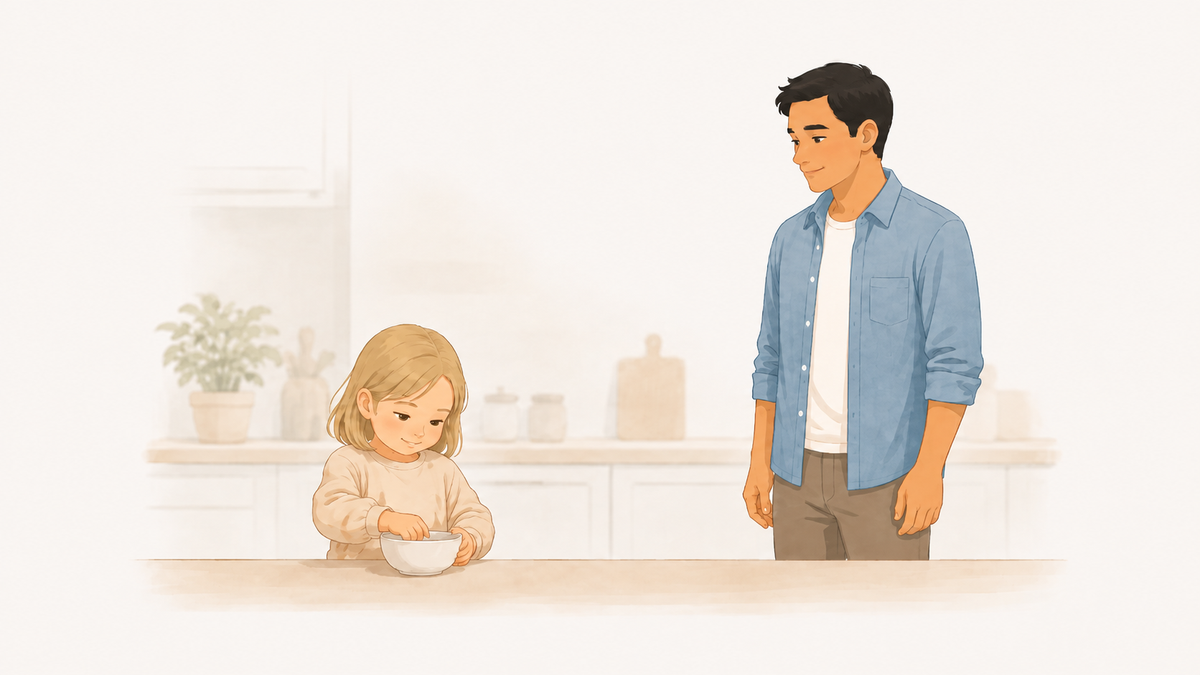
The first time I asked my toddler if she wanted to help me cook, she lost her mind about it. Full enthusiasm. I had her in there immediately, my hand over her hand, narrating a box of mac and cheese like it was a cooking show. The second time, she put her hand down on the spot where the pan had just been. Half a second. Nothing happened, but it could have.
So now we have a system. I get everything ready, I take the pan off, and then I call her over. I stand a couple of steps back and give her directions, and she follows most of them. "Be careful and stir slowly, otherwise it's going to go everywhere." She may or may not slow down. Or she doesn't push hard enough and she's just moving the top layer around in a circle.
Either way I say "great job," and then I finish it.
She wants to help every single time, so I've been telling myself this is working. I don't think she's actually learning how to do it. She's learning that I'll finish it.
I'm not telling you that as a mistake I already fixed. Two of the things I say at that stove are on the list further down of things not to say.
The method below is what it looks like when I'm doing it right. Same five moves whether the skill is cracking an egg or reading a bank statement. It isn't clever. It's mostly a set of rules for keeping my own hands out of it.
Why Teaching a Kid Anything Is Harder Than Doing It Yourself
Because it is slower, messier, and worse.
That's the whole obstacle. Every time you hand a task to a kid, the immediate result gets worse. The eggs have shell in them. The bed looks like a crime scene. The four minute job takes nineteen.
So you take it back. Not out of impatience, usually. Out of efficiency, which is a much more respectable reason to do the wrong thing.
Here is the trade you're actually making. You get a clean kitchen tonight and a kid who still can't cook in ten years. Nobody would take that deal if it were presented that way. It never is. It shows up one Tuesday at a time.
The second obstacle is quieter. We tend to think of teaching as talking. So we explain. We explain the whole thing, front to back, with the reasons, before they've touched anything. Then we're annoyed when they don't remember the fourth step. Nobody learns a physical skill from a lecture. They learn it from doing it badly several times in a row.
The Five-Step Method
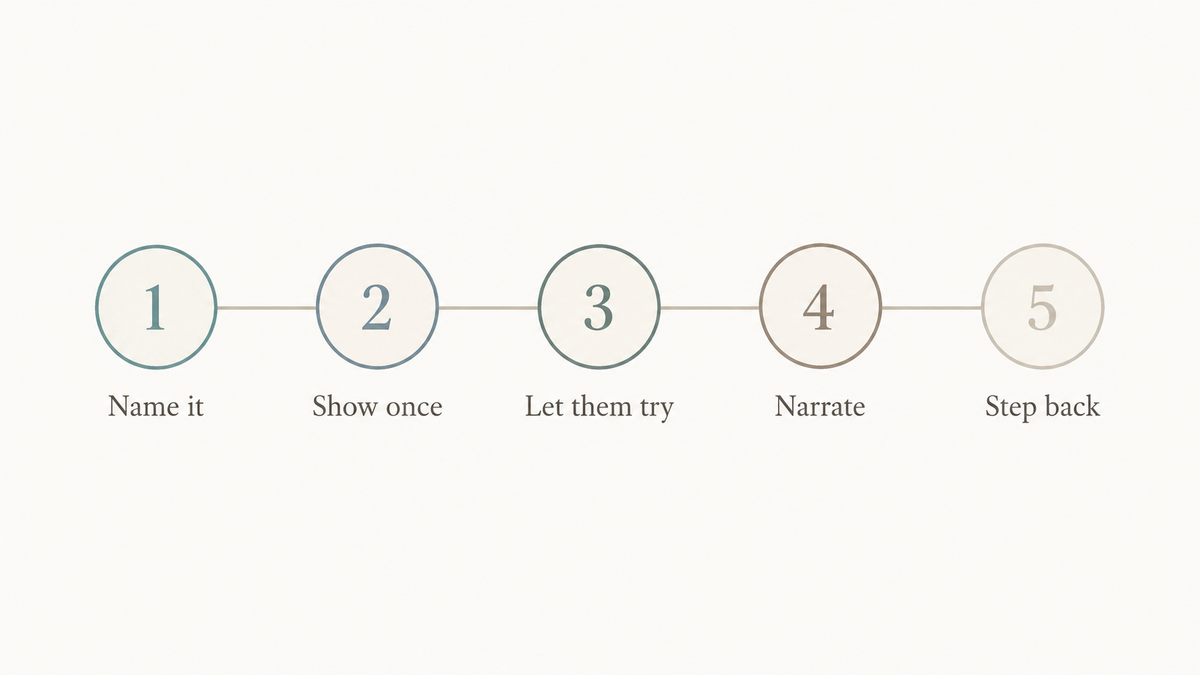
Five steps, in order, for any skill:
- Pick one skill and name it. One thing, said out loud, so you both know what today is about.
- Show it once, slowly. One demonstration, narrated. Then stop.
- Let them do it badly. Hand it over and keep your hands off it.
- Narrate, don't grade. Describe what happened instead of scoring it, then ask what they noticed.
- Step back a little each time. Remind them of one fewer thing every round until you're not needed.
That's it. The rest of this article is what each step actually looks like and where it goes wrong.
Step 1: Pick One Skill and Name It
One skill. Not the whole kitchen. Not "learning to cook."
Pick a single thing with a beginning and an end, say it out loud, and make it the only thing you're teaching today. "Today you're learning to crack an egg without getting shell in the bowl." "Today you're learning to start the laundry."
Naming it does two things. It gives both of you a finish line, which matters more than it sounds like it does. And it stops you from bolting four other lessons onto the first one, which is the thing every parent does and every kid hates.
The naming also keeps you honest about scope. If you can't say the skill in one sentence, it isn't one skill. It's a category, and you're about to overwhelm somebody.
How to pick the first one: choose something they will do again this week. Repetition is doing most of the work here. A skill they perform once a season won't stick no matter how well you teach it.
Step 2: Show It Once, Slowly
Do it yourself first. Slower than feels natural. Say what you're doing while you do it, in short pieces.
Then stop.
One demonstration. This is the part people get wrong in the generous direction. If you show it five times, you have done it five times and they have done it zero. It feels like teaching. It is actually just you doing the task with an audience.
Slow matters because competent adults skip steps. You don't notice that you tap the egg twice and check the pan with the back of your hand, because you stopped noticing years ago. Going slow forces the invisible parts back into view. That's most of what you're transmitting.
Say the reason only when the reason changes what they do. "Wipe the dipstick first, otherwise you're reading the old oil" is useful. A history of internal combustion is not.
Step 3: Let Them Do It Badly
Hand it over. Then let them be bad at it.
This is the step the whole method lives or dies on, and it's the one that physically hurts. They will be slow. They will do it in an order that makes no sense. They will hold the tool wrong in a way that isn't dangerous, just wrong, and you will want to fix it.
I don't have a trick for this part. What I have is a sentence I say to myself, which is that it's good for her to be bad at this right now, and that the only thing that overrides it is danger. I say it a lot. Several times a day, some days. It works about as often as it doesn't.
The wobble is not a problem with the lesson. The wobble is the lesson. A kid who is never allowed to do it wrong never gets the information that tells them how to do it right. You can't hand that over. It has to be earned by a bad attempt.
The two exceptions. Step in for real danger and for real damage. A hot pan tipping, a knife moving toward a hand, a tool about to break. Everything else, including a mess and including a wasted ingredient, is inside the price of the lesson.
What to do with the urge to help. Give yourself a job. Wipe a counter. Hold the bowl. Stand two steps further back than feels right. The urge is not going away, so it needs somewhere to go that isn't their hands. Problems that start small are worth catching early. A crooked pancake is not one of those problems.
Step 4: Narrate, Don't Grade
When they finish, describe what happened instead of scoring it.
"The pan was hotter than last time, that's why it stuck" gives them something to use. "That's wrong" gives them nothing but a feeling. Same information, different owner.
Then ask the question that does most of the work:
"What did you notice?"
You are trying to build a kid who can correct themselves when you are not in the room. That only happens if they do the noticing. If you always supply the diagnosis, you become part of the equipment, and the skill doesn't travel without you.
Two more that earn their keep:
- "Show me how you'd start." Use it before you explain anything next time. Where they start tells you more than anything they say.
- "Try it again. I've got time." Half of teaching is just not being in a hurry. Say it even when it's a small lie.
And the ones to drop:
- "Here, let me just do it." Steals the rep. The rep is the entire skill.
- "You're so smart." Praises the trait instead of the work. Praise the strategy.
- "Be careful." Means nothing. Name the actual thing to watch.
- "Why can't you get this?" They don't know. Not knowing is what still learning means.
Two of those are things I say at the stove most weeks. I know they're on the list. I wrote the list.
Step 5: Step Back a Little Each Time
Next round, remind them of one fewer thing. Then one fewer than that.
This is the step people skip, and skipping it is how a kid ends up able to do a task only while you're standing there. Supervision is comfortable. It also quietly becomes part of the skill unless you deliberately remove it.
A rough ladder:
- You do it, they watch.
- They do it, you talk them through it.
- They do it, you're in the room and quiet.
- They do it, you're somewhere else in the house.
- They do it, and you find out later because it's done.
The ladder isn't mine. It's a version of what teachers call gradual release of responsibility, which Pearson and Gallagher named in 1983 and which goes back further than that to Vygotsky. Their version has three or four rungs. I split the last one into three, because in a house the difference between standing in the room and being in another room is enormous.
Most families stall at level two for years. Moving up a rung feels like a risk every single time, which is why it has to be a decision instead of something you wait to feel ready for.
The day they do it without you in the room, you didn't lose a job. You finished one.
Where This Actually Goes Wrong
Four failure modes, and I have run all four.
You're in a hurry. The method needs slack. When there's none, don't fake it. Do the task yourself, out loud, and say the true thing: "I'm doing this one because we're late. You're doing the next one." Then actually let them do the next one, or you've taught something worse than nothing.
They want to quit the second it's hard. Break, not quit. "Get a snack. We'll try it one more time in twenty minutes." The distinction matters because quitting at the first friction is itself a habit, and it's more contagious than any single skill.
They don't care about the skill. Attach it to something they do care about. Not budgeting, the concert. Not knife skills, the specific dinner they've been asking for. Same skill, a reason that belongs to them.
They do it wrong and it costs something. Let the cost land, as long as the cost is survivable. Slightly burnt dinner, eaten. A shrunken shirt, worn. "Nobody's hurt. What would you do differently?" The consequence teaches faster and more permanently than you do, and it doesn't require you to be the bad guy.
Picking the First Skill
Start with something they already want to do, or something they're already sort of doing badly on their own.
Good first candidates: making one breakfast start to finish, running a full load of laundry, packing their own bag the night before, making a phone call to a stranger, helping with something real in the kitchen instead of a pretend job.
For older kids, the same method applies to bigger skills without modification. The list of things worth handing over before they leave home is longer than most of us think, and being able to cook a few meals is usually the one that pays off first.
One skill. Run the five steps. Then pick the next one.
Teach Your Kid Almost Anything is a free starter framework for raising a capable kid. A simple five-step method that works on almost any skill, plus a competence inventory to work through over the years. Download it free →
I was around for a lot of work growing up. My dad fixing the car, cleaning the pool, building a computer on the kitchen table. I was right there for most of it. He never asked if I wanted to try, and I never asked either, and I think both halves of that matter.
Nobody was cruel about it. Nobody said no. It just never occurred to anyone to say here, you do this part.
None of this is fast, and that's the part I keep having to accept. You don't get a capable kid from one good afternoon of teaching. You get one from a couple hundred ordinary handoffs where the outcome was worse than it would have been if you'd just done it yourself.
Which is why I keep going back to the stove with a two year old and a pot of mac and cheese I could make correctly in four minutes.
Competence is quiet. You won't get a moment where it lands. You'll just notice, at some point, that they stopped asking you to do the things they can now do themselves.