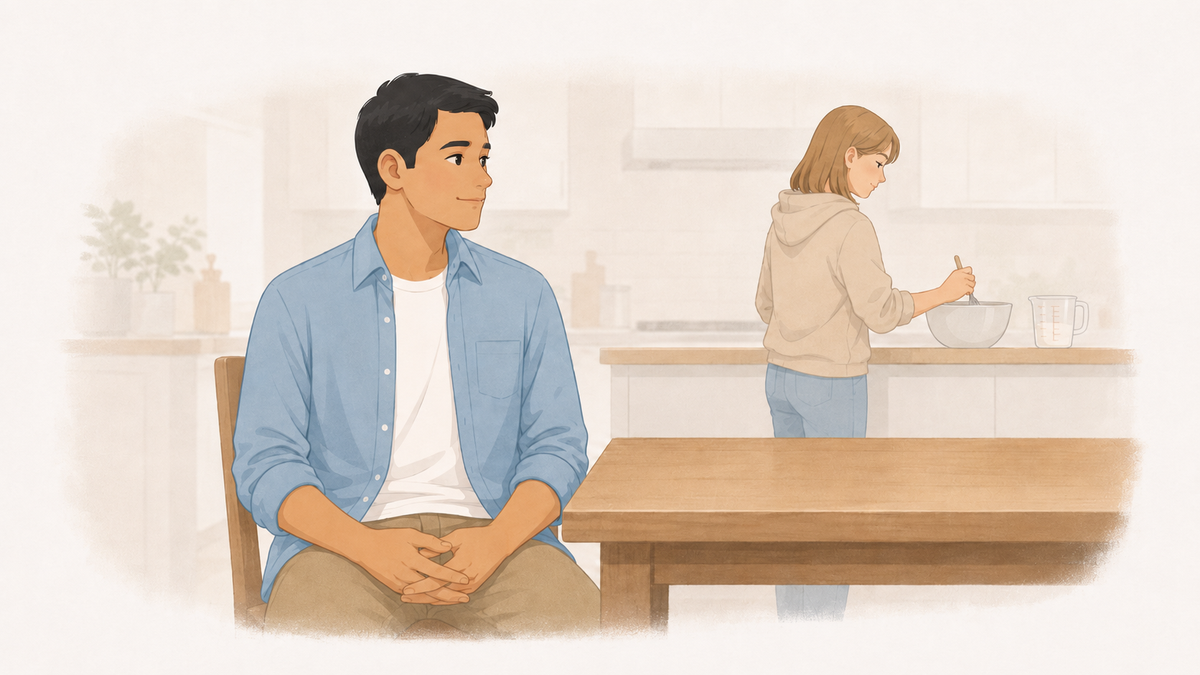
Almost nobody decides to do everything for their kid.
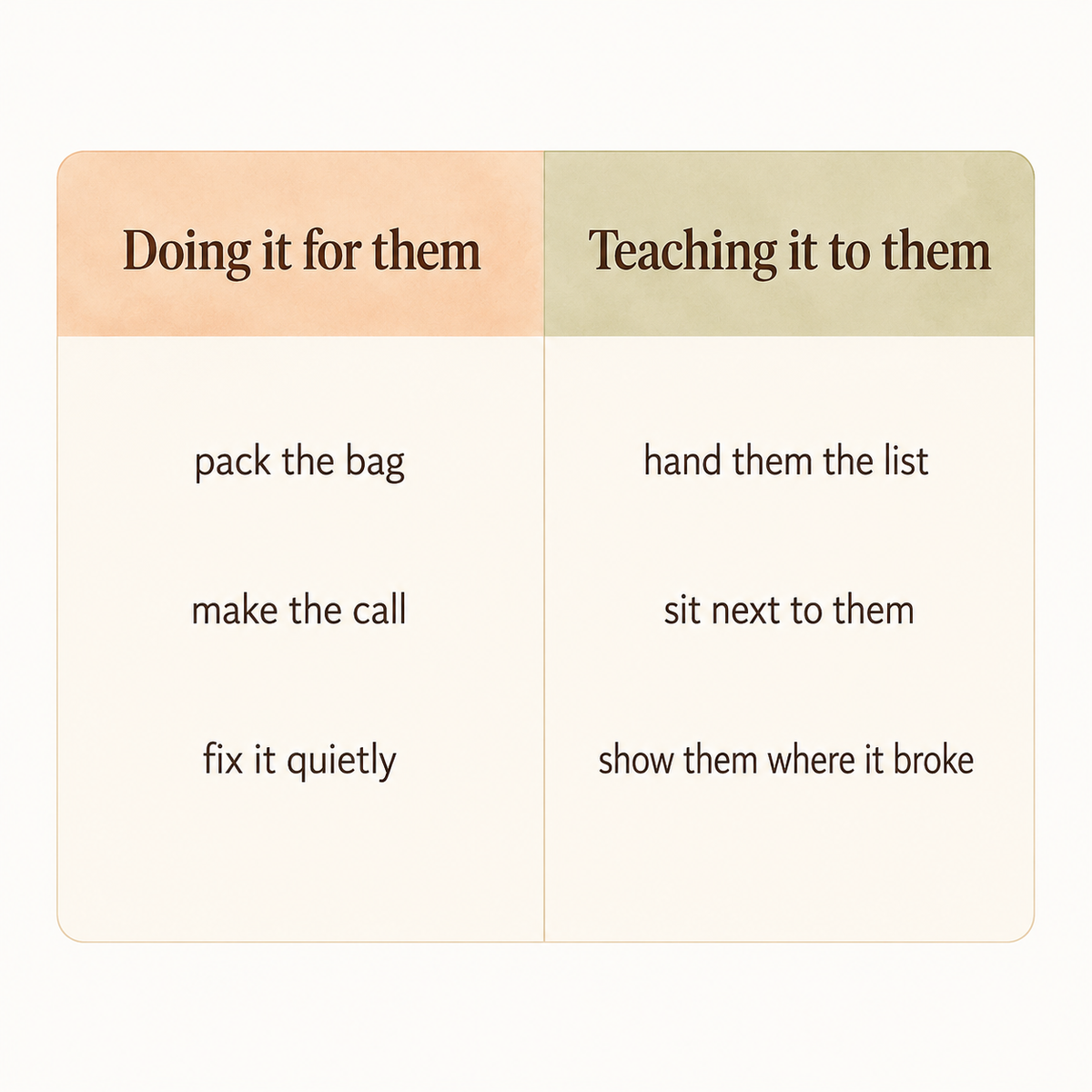
What happens instead is that you make about four hundred small, sensible, individually correct decisions. You pack the bag because you're already standing there. You call the school because you can do it in one minute and they'd need ten. You fix the thing before they notice it's broken, because why would you leave it broken.
Every one of those is defensible on its own. Stacked up over a decade, they add up to a teenager who genuinely does not know how to call a stranger on the phone.
That's the actual mechanism. Not smothering. Efficiency.
Mine is teeth.
My toddler can brush her own teeth. She's been able to for months. But it's the end of the night, and she is unbelievably slow about it, and I am standing right there. So more often than I want to admit I just take the toothbrush and do it myself, and it takes eleven seconds instead of four minutes.
I catch it maybe half the time. When I do, I hand it back and say "you can do this," which is true, and which she already knows, and which is mostly me talking to myself.
The Belief Underneath It
The reason this is hard to see is that helping feels like the whole job.
We know what a bad parent looks like. Absent, indifferent, not paying attention. So we calibrate against that, and by that measure, doing more is always safer than doing less. Every extra thing you handle is more evidence that you're not the other guy.
Here's the problem with that measurement. The absent parent and the parent who does everything produce a similar outcome on this one specific axis: a kid who arrives at eighteen without the skills. Different roads, same destination. One of them just feels much better on the way there.
Doing things for your kid is not the same as caring about your kid. It's the substitute we reach for when caring is hard to demonstrate any other way.
What It Actually Looks Like
Learned helplessness is a clinical-sounding term for a very ordinary thing. It's what happens when a kid gets enough evidence that trying isn't the thing that produces results. Asking is.
It doesn't present as laziness. It presents as:
- Asking where something is instead of looking for it
- Going quiet and waiting when a task gets slightly hard
- "I don't know how" as the first response rather than an attempt
- Genuine surprise that a normal adult task is something they're expected to do
- Needing a parent present to start something they've done before
None of that is a character problem. It's an accurate read of the environment. If asking has worked two thousand times and trying has been interrupted two thousand times, then asking is simply the better strategy and they've correctly identified it.
Which means the fix isn't motivation. You can't lecture a kid out of a strategy that works. You have to change what works.
The Four Reasons We Keep Doing It
It's faster. True, every single time, in the moment. And it's the reason that never stops being true, which is why it wins so often. The math only flips when you count the next ten years, and nobody does that math at 7:40 in the morning.
It's how we show love. Doing things for people is a real language of care. It's just a language that has to change as they age, and it usually doesn't. The version of it that works for a six year old is smothering at sixteen and identical in intent.
We can't stand the standard. The bed is wrong. The email is too casual. The dinner is not what we would have made. Some of this is legitimate and most of it is preference dressed as quality control.
It's part of who we are now. This is the one people don't say out loud. Being needed is load-bearing. If they can do it themselves, some quiet part of the job description disappears, and that's a real loss even when it's the goal.
That last one deserves more honesty than it usually gets. The discomfort of stepping back isn't only about whether they'll manage. Some of it is about you.
The Better Mental Model
The reframe that makes all of this simple:
Your job is not to take care of them. Your job is to make yourself unnecessary.
Care is still in there. It's just the method, not the goal. Under this model, every task you hand over is progress and every task you keep is a small debt you'll pay later.
It also fixes the emotional problem, which is that stepping back feels like abandonment. It isn't. It's the actual work. A parent who has made themselves unnecessary on forty skills has done forty times more parenting than one who has stayed essential on all of them.
You have roughly eighteen years to run this. That sounds like a lot until you notice that most of the handovers happen in the last four.
Find Out What You're Still Doing
Before you change anything, spend a week just noticing. No adjustments, no announcements. Keep a note on your phone.
Every time you do something for a kid, write down one line: what it was, and whether they could have done it. Don't optimize during the week, you'll ruin the data.
At the end, most people find three categories:
- Things they genuinely can't do yet. Fine. Leave them. This pile is smaller than you expect.
- Things they could do but never have. This is the pile that matters. Almost everything in it is there because of momentum, not capability.
- Things they can do and you're doing anyway. This is the uncomfortable pile. Usually it's things where your standard is higher, or where you're faster, or where it's become a habit neither of you has examined in years.
Start with pile three. Those are free. The skill already exists and all you have to do is stop.
The chore list by age is a decent reality check on pile two if you're not sure what's reasonable: what kids can actually handle at each age.
Hand It Back, One Thing at a Time
Not all of it at once. A sudden announcement that things are changing around here produces a fight and lasts nine days.
Pick one thing a month. One. It's slower than you want and it's the only pace that survives contact with a normal week.
Tell them it's theirs now, out loud. Not as a punishment, as a promotion. "This is yours from now on. I'll show you once and then I'm out."
Teach it properly instead of just dropping it. Dropping a task on a kid who has never done it is how you end up taking it back within a week, having proved to both of you that they couldn't handle it. Run the five steps on it: name it, show it once, let them do it badly, describe what happened instead of grading it, then step back a rung at a time.
Then hold the line for about three weeks. They will test whether you meant it. Not out of defiance, just because asking used to work and it's worth checking whether it still does. If you take it back once during that window, you've taught that persistence beats the new rule, and you get to start over.
Let small things fail. The forgotten homework, the shirt that wasn't washed, the missed sign-up. Every one of these is a cheap lesson at fourteen and an expensive one at twenty four. Problems start small, and the ones your kid solves themselves at this size are the ones that stay small later.
The line I'd hold: step in for anything that's genuinely unsafe or permanent. Everything else is tuition.
The Part Nobody Warns You About
It's uncomfortable in a way that doesn't fade for a while.
Watching your kid do something slowly and badly that you could do quickly and well activates something almost physical. It's not patience you need. Patience implies you're calmly waiting. This is closer to sitting still while something in you objects.
It also gets quiet at home in a way you might not like. Fewer requests. Fewer moments of being the one who knows. That's the trade, and it's worth naming honestly instead of pretending the whole thing is a clean win.
What you get in exchange is a kid who becomes reliable, which is a thing that can't be given and has to be built, one dropped and recovered ball at a time.
Teach Your Kid Almost Anything is a free starter framework for raising a capable kid. A simple five-step method that works on almost any skill, plus a competence inventory to work through over the years. Download it free →
Pick one thing this week. Something small enough that failing at it costs nothing.
Tell them it's theirs. Then go do something else in another room, which is harder than it sounds and is most of the job.