This article contains affiliate links. As an Amazon Associate I earn from qualifying purchases.
Cooking is the skill I'd hand over first if I could only hand over one.
Partly because it's daily, so the repetitions are free. Partly because it's one of the few skills where a kid can see the whole arc in twenty minutes: they did a thing, and now there's food, and people are eating it. Not much else in childhood works that way.
And partly because the alternative is what happened to a lot of us, which is arriving at eighteen able to operate a microwave and nothing else.
The barrier isn't teaching. It's that a kitchen with a kid in it is slower, messier, and mildly alarming. Every reason not to start is a good one.
Start Earlier Than Feels Right
The window opens around two, which is roughly a decade before most people use it.
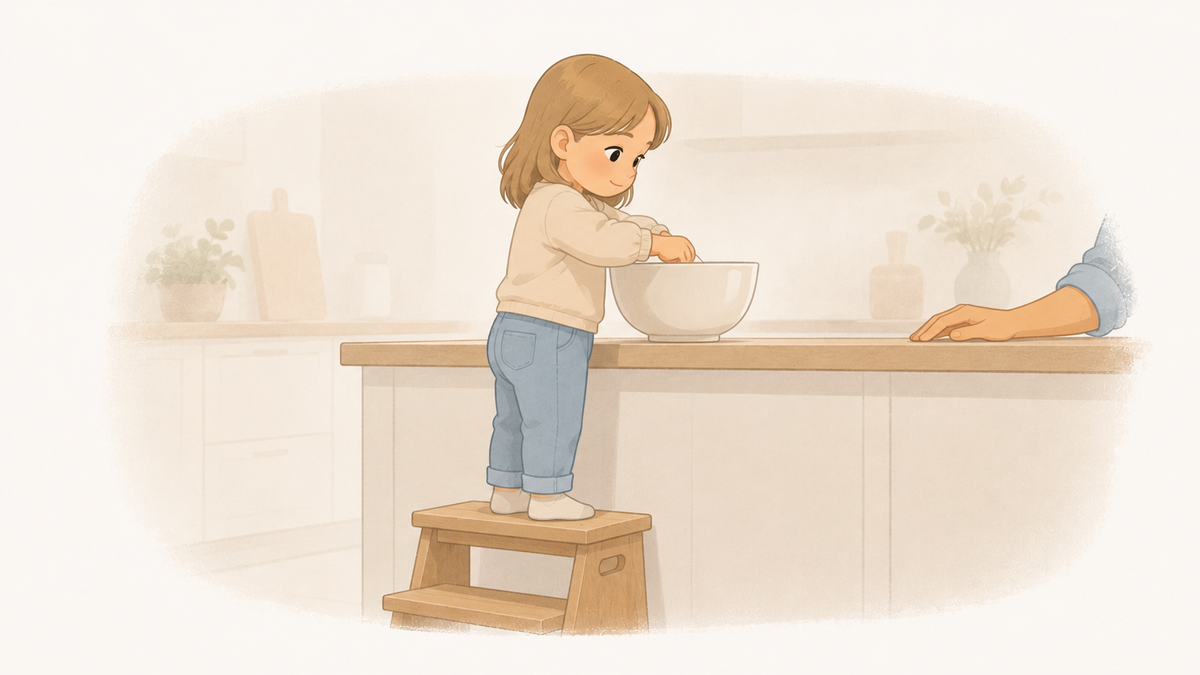
A two year old cannot cook. A two year old can absolutely wash vegetables, tear lettuce, and pour something you pre-measured, and the reason to let them is that at two they want to. That want has a shelf life. By nine, cooking is a chore. At two, it's the best thing happening that day.
Letting a toddler into a real task costs you about fifteen extra minutes and a counter to wipe. That's the actual price, and it's the lowest it will ever be.
Kitchen Skills by Age
Ages 2 to 3
- Wash vegetables and fruit
- Tear lettuce and herbs
- Stir cold ingredients
- Pour pre-measured liquids
- Press buttons on the blender, with you on the lid
- Carry unbreakable things to the table
Ages 4 to 5
- Measure and level dry ingredients
- Crack eggs, badly at first
- Spread with a butter knife
- Cut soft foods with a kid-safe knife
- Set a timer and report when it goes off
- Set the table completely
Ages 6 to 8
- Read a simple recipe and say what's needed
- Use a peeler
- Use a real paring knife on soft foods, supervised
- Operate the toaster and microwave
- Crack and scramble eggs at the stove with you standing there
- Make their own breakfast start to finish
Ages 9 to 11
- Use the stovetop for a full dish, supervised nearby
- Chef's knife on standard vegetables, with technique taught
- Use the oven with supervision
- Cook one meal for the family from a recipe
- Plan the order of a two-part meal so both parts land at once
- Clean as they go, which takes years, and this is where it starts
Ages 12 and Up
- Cook unsupervised
- Adapt a recipe or substitute an ingredient without panic
- Cook dinner for the family on a schedule, weekly
- Shop for their own ingredients from a list
- Handle raw meat and know the temperatures
- Feed themselves properly on a day when nobody is home
The last one is the actual objective. Everything above it is scaffolding.
Tools That Make It Safe to Start
Most kid kitchen gear is a toy. Three things aren't.
A step stool. This is the one that changes everything and it's the one people skip. A kid who can't reach the counter can only participate in whatever you bring down to them, which is a fake job and they can tell. A sturdy two-step stool puts them at working height and instantly triples what they can do. Get one with a real footprint, not a folding plastic one that slides.
A kid-safe knife. A kid safe nylon knife set will cut bananas, strawberries, cooked potatoes, and mushrooms, and they cannot cut a finger. The point is not the cutting. The point is that a three year old holding a knife-shaped object learns the grip and the posture and the seriousness a year or two before they get anything sharp, so the real handoff isn't starting from zero.
For a six or seven year old who's outgrown nylon and isn't ready for a chef's knife, the Opinel Le Petit Chef set is the step up worth paying for. It's an actual small knife with a finger guard ring that physically holds the free hand in the claw position. The guard trains the habit that keeps the fingertips back, which is the whole ballgame, and then it comes off.
A cutting board that doesn't move. Wet paper towel underneath. That's the whole tip, it costs nothing, and a sliding board is responsible for more kid kitchen injuries than sharp knives are.
Skip the plastic play kitchen sets marketed as training tools. A kid using a real peeler on a real carrot is learning. A kid with a toy is playing, which is fine, but it isn't this.
When Can Kids Use a Real Knife?
The honest answer is that it depends on the kid. The ages below are a starting point, not a permission slip:
- Around 3: a nylon kid-safe knife on soft food
- Around 6: a small real paring knife on soft food, with you within arm's reach
- Around 9: a small chef's knife on standard vegetables, with technique taught properly
- Around 12: normal kitchen knives, unsupervised
I'd rather you gate the graduations on what a kid can actually do than on a birthday. Same logic as a learner's permit: the date makes them eligible, the driving makes them ready. Mine had a nylon knife at two and handles it fine, which tells you how little the number is really doing on its own.
Move them up a level when three things are automatic: they hold the claw without being reminded, they keep the board still, and they put the knife down instead of handing it over. All three are observable from across the kitchen. If they aren't automatic yet, a birthday doesn't change anything.
What matters more than the age is the order you teach it in. Teach the grip before you teach the cutting.
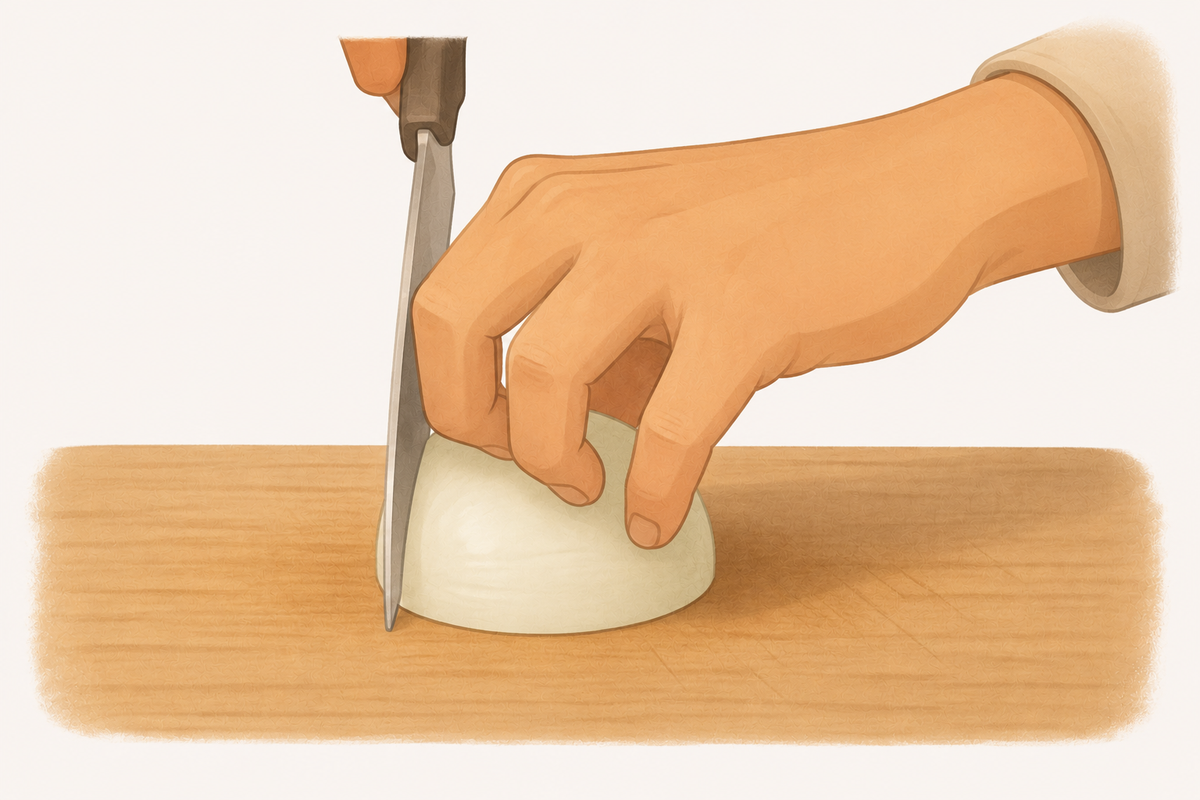
- The claw. Free hand curls, fingertips tucked back, knuckles forward. The knife rides against the knuckles. Practice it on a banana with a butter knife, with no cutting involved, until it's automatic.
- The board doesn't move. Wet towel underneath, every time.
- Flat side down. Cut a round vegetable in half first so it can't roll. Rolling is what causes the cut.
- Slow is the technique. Not a beginner's version of the technique. Speed is a side effect of doing it correctly a thousand times, and chasing it early is how people get hurt.
- Put it down, don't hand it over. Knife goes on the board, then the other person picks it up.
A dull knife is more dangerous than a sharp one because it slips. If you're going to let a kid use a knife, sharpen it first.
The Heat Question
Stovetops scare parents more than knives, and the risk profile is roughly the same: real, manageable, worth teaching directly.
Handles turn inward. First rule, taught on day one, enforced forever.
They approach from the side, not over the top. Steam burns and people forget about steam.
One pan at a time when they're learning. Two pans is a different skill and it's the one that produces panic.
Teach the shutdown before the startup. Which knob turns it off, and where the lid is if something flares. A kid who knows how to stop it is a kid who can be allowed to start it.
Expect the stove to do some of the teaching. I am not going to tell you to let your kid get burned on purpose. What I'll say is that nothing I have ever said out loud has taught as fast as one bad moment near a hot pan, and that "be careful" was never going to work anyway. My toddler put her hand down where a pan had just been. Half a second, nothing happened, and it changed how I run the entire kitchen. Your job isn't to arrange that lesson. It's to keep the version she gets survivable, and to name the actual thing to watch instead of saying be careful. That's the right size of struggle: real enough to matter, small enough to recover from before dinner.
A Cookbook They Can Own
There's a difference between cooking with you and having their own thing.
Give a kid a cookbook that belongs to them and something shifts. They flip through it when they're bored. They pick the thing. They come to you with a plan instead of waiting for an assignment, and that's a different relationship to the kitchen entirely.
The Complete Cookbook for Young Chefs is the one worth buying for the six to twelve range. Real recipes rather than novelty ones, written to be read by the kid instead of by a parent out loud, with the technique explained rather than assumed.
Let them pick. Even when what they pick is a bad idea for a Tuesday.
The First Five Recipes
Pick things with a short path from start to eating.
- Scrambled eggs. Heat control, timing, and the discovery that low and slow beats high and fast. The whole foundation in one pan.
- A quesadilla. Flipping, melting, cutting, and a payoff in four minutes.
- Pasta with something. Boiling water, timing, salting, and the first taste-and-adjust moment.
- A sheet pan dinner. Chopping, seasoning, oven, one dish. Very hard to ruin.
- Something baked. Measuring exactly, following an order that can't be improvised, waiting. Baking teaches precision the way nothing on the stovetop does.
When they can do all five without a recipe, they can feed themselves, which is the handful of meals that actually carries a person through their twenties.
How to Run the Lesson
Same five moves as any other skill, just in a room with heat in it.
Name one thing. Show it once, slowly, saying what you're doing. Hand it over and let it be bad. Describe what happened rather than grading it, and ask what they noticed. Then step back one rung next time.
Two kitchen-specific additions:
Set up before they arrive. Pre-measure, clear the area, move what shouldn't be touched. The prep is yours, the task is theirs. This is what makes it possible to actually leave your hands out of it.
Let them eat the mistake. Slightly burnt, over-salted, weird. Nobody's hurt and the feedback is immediate and it isn't coming from you, which makes it land completely differently. Cooking is unusually good at this. Most skills don't tell you the truth at the end.
Teach Your Kid Almost Anything is a free starter framework for raising a capable kid. A simple five-step method that works on almost any skill, plus a competence inventory to work through over the years. Download it free →
The kitchen is the easiest classroom in the house. It runs every day whether you use it or not, the lessons are short, and the feedback is honest.
You're not raising a cook. You're raising somebody who, at some point, is going to be hungry and alone and completely fine.