This article contains affiliate links. As an Amazon Associate I earn from qualifying purchases.
My toddler wants to help with everything.
Changing light bulbs. Cleaning the patio. Cooking dinner. It doesn't matter what I'm doing. She shows up and she wants in.
My first instinct is always to figure out what she can handle and hand her exactly that task. Which sounds reasonable. The problem is I'm usually wrong about what she can handle, and without realizing it, I've been limiting her.
The Lesson
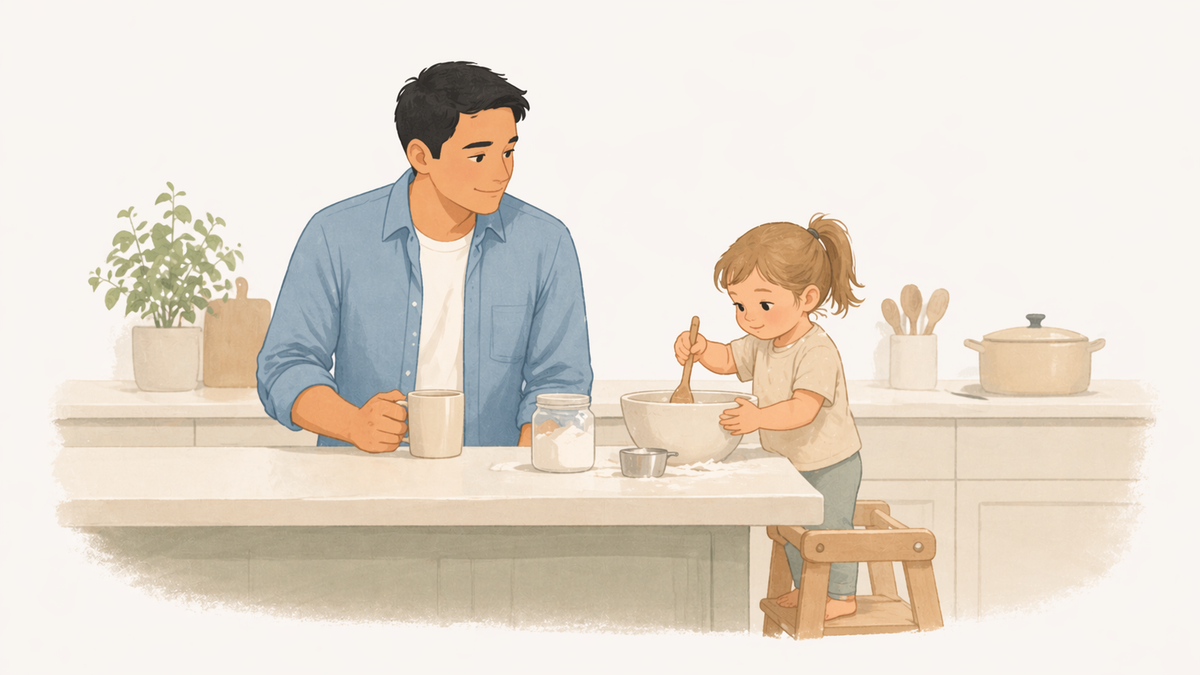
A while back I was making chicken drumsticks and some mac and cheese for her. She came into the kitchen and said what she always says: "Help Daddy."
I'd already pre-measured everything for the cheese sauce. Milk, butter, the cheese powder, all set out on the counter. I had her step stool ready. I turned off the burner before bringing her over.
I did everything right. And she still got a little too close to something I was sure I'd accounted for. She pulled back immediately and looked at me, eyes wide. I took care of it and she was fine in a few minutes.
But I sat with that for a while.
Was I wrong to have her involved? I kept going back and forth. I tell her constantly what not to touch, what's hot, what's off limits. Her curiosity got ahead of her that day. That's not a failure of preparation. That's just being two.
What child development researchers call "scaffolded learning" is essentially what I was already trying to do without knowing the name for it. You set up the task so the child can succeed at just slightly beyond what they can do independently. You stay close. You let them try. The goal isn't a perfect result. The goal is that they did something real, with your support, and came out more capable.
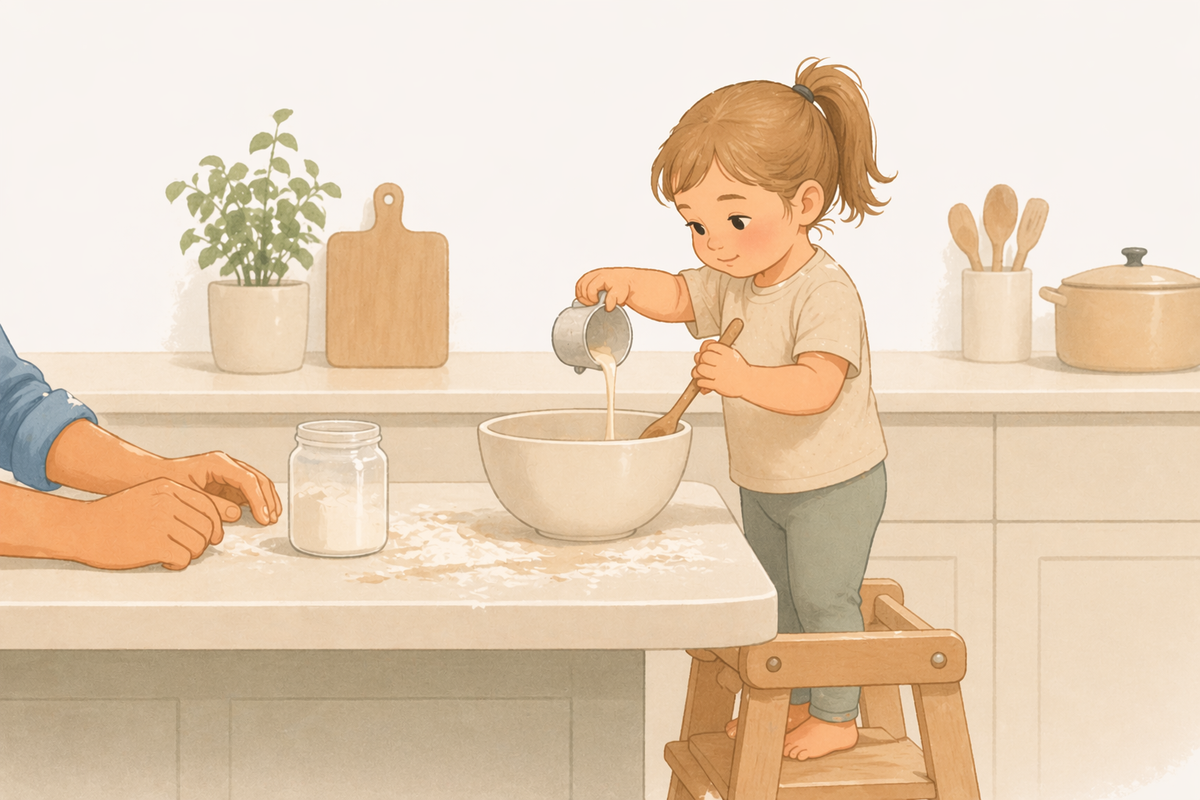
Research consistently shows that children as young as two can participate meaningfully in the kitchen. Washing vegetables. Stirring. Pouring pre-measured ingredients. These aren't just cute tasks. They build fine motor skills, improve confidence, and make kids significantly more willing to try new foods. Studies from Utah State University's extension program and others have found that kids who help prepare food are more invested in eating it and more open to variety.
None of that happens if we're always deciding the kitchen is too complicated for them.
The hard part isn't finding the right task.
It's accepting that something might still go sideways even when you've prepared well. And then letting them help again anyway.
The Real Skill
Letting kids help is slower. Messier. Things don't come out perfect.
And the hardest part isn't any of that.
It's the moment when something almost goes wrong. The near miss. The thing you prepared for and it still happened. That's the moment most parents pull back and decide it's just easier to do it themselves.
But the research is consistent: kids who are included in the kitchen regularly develop better fine motor control, stronger confidence, and a healthier relationship with food. They eat more variety. They understand where things come from. They feel capable.
That feeling of being capable is its own reward. And it compounds.
You don't have to hand over the whole kitchen. But you can probably hand over more than you think.
Same idea applies once they're ready to cook a few meals on their own.
Try This
1. Start with tasks that are genuinely theirs. For a two-year-old: washing vegetables, tearing lettuce, or pouring something pre-measured. For a four-year-old: stirring, measuring, and simple cutting with a kid-safe knife. Match the task to the child.
2. Set up the work before they arrive. Pre-measure. Clear the area. Remove what shouldn't be touched. Then bring them in. The prep is yours. The task is theirs.
3. Stay close, but don't take over. Your job is to be there, not to do it for them. Resist the instinct to jump in the moment something looks imperfect.
4. Name what's dangerous, clearly and often. They will forget. Tell them again. This is not a failure. It's how toddlers work.
5. Give them a little more each time. Not all at once. Just one more step than last time. That's the whole system.
A pair of Nordic Ware sheet pans makes sheet-pan dinners possible with a toddler at the counter. Kids can load them. Kids can't break them.
Teach Your Kid Almost Anything is a free starter framework for raising a capable kid. A simple five-step method that works on almost any skill, plus a competence inventory to work through over the years. Download it free →
I still catch myself assuming her limits before she's had the chance to prove otherwise.
I'm not a child development specialist and I'm not pretending I have this figured out. But I'm trying to remind myself that the goal isn't a perfect cooking session. It's a kid who grows up feeling capable in the kitchen.
That's worth the mess.
That's worth the extra time.
And most of the time, she surprises me anyway.
That's how paying attention actually pays off. You stop assuming and start seeing what's in front of you.