This article contains affiliate links. As an Amazon Associate I earn from qualifying purchases.
There's a quiet assumption underneath a lot of parenting, which is that independence arrives.
That somewhere around eighteen a kid crosses a line and becomes a person who can handle their own life. We half know this isn't true and we mostly act like it is, which is how you end up with a nineteen year old calling home to ask how to make a doctor's appointment.
Independence isn't a stage. It's an inventory. It's a list of specific things that used to be yours and are now theirs, and the list only moves if somebody deliberately moves it.
The teenage years are when that list has to clear, and there are fewer of them left than it feels like.
The Handover Problem
Here's the shape of it. For about twelve years, you ran everything. Then, over roughly four years, all of it is supposed to transfer.
That's a lot of transfer in a short window, and it collides with the worst possible conditions: a kid who is simultaneously demanding more freedom and demonstrating questionable judgment, and a parent who now has actual consequences to worry about instead of a spilled bowl.
So the handover stalls. Not from a decision. From the fact that every individual handover looks slightly unwise this particular month.
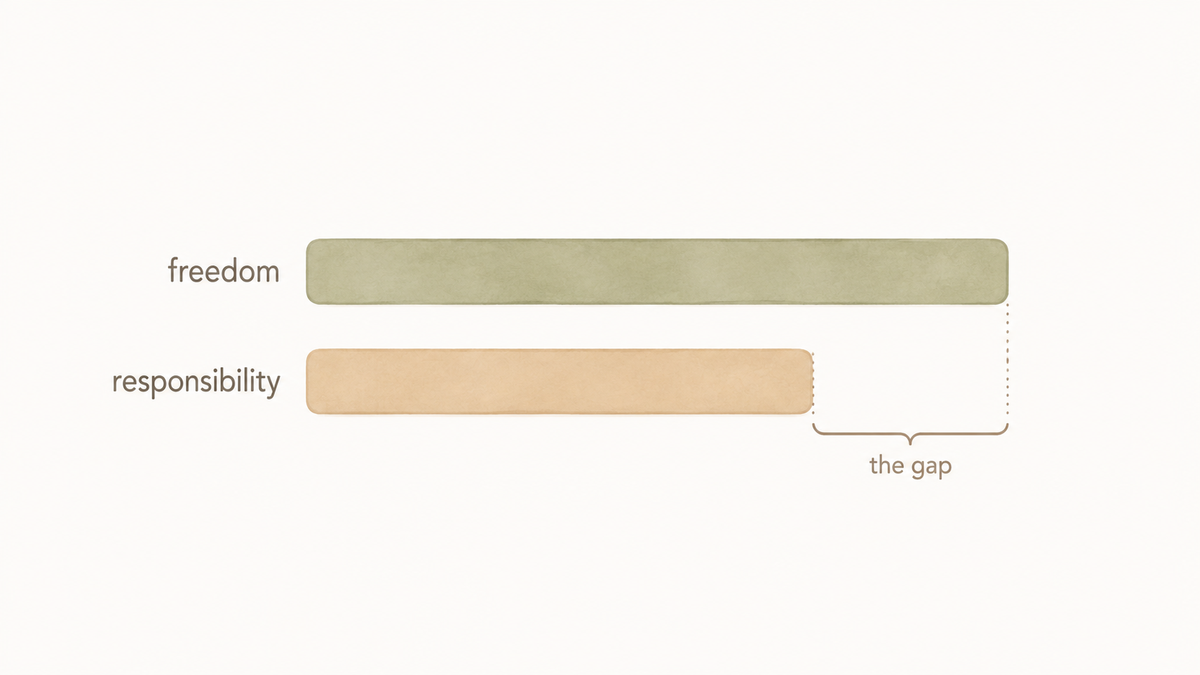
And there's a second thing, which is that teenagers ask for autonomy and independence in a specific, narrow way. They want to go places. They rarely ask to take over the insurance paperwork. So the freedom gets granted and the responsibility doesn't, and those are supposed to be the same transaction.
The rule I'd hold: freedom and responsibility move together. Every new privilege comes attached to the boring administrative half of itself. Later curfew comes with owning the communication about where you are. Car access comes with fuel, tire pressure, and noticing the noise it started making.
What to Hand Over, Roughly When
Ages are approximate and kids vary wildly. The order matters more than the timing.
Ages 13 to 14
- Their own laundry, entirely, with no reminders
- Their own schedule and deadlines, on a calendar they maintain
- Cooking dinner for the family once a week
- Managing their own homework without a parent checking
- Making a phone call to a stranger: an appointment, a question, an order
- Waking up to their own alarm
Ages 15 to 16
- A bank account they actually operate
- Grocery shopping from a list with a budget
- Emailing a teacher or a coach directly about their own problem
- Their own medical appointments, including saying what's wrong out loud
- Basic car care if they're driving: fuel, tire pressure, checking the oil
- Handling a plan that falls apart without calling home first
Ages 17 to 18
- Managing their own money across a month, including the shortfall
- Sorting out a conflict with an adult who isn't family
- Anything paperwork shaped: forms, deadlines, applications
- Planning something with real logistics, start to finish
- Feeding themselves properly for a week with nobody home
- Knowing what to do when something goes genuinely wrong, and doing it before calling
The full skills inventory is here if you want to audit against it: the life skills worth teaching before they leave home.
The Four Categories
If the list above is too much, everything on it belongs to one of four buckets. Audit these instead.
Self-management. Waking up, showing up, tracking their own commitments, noticing when they're behind. This is the one that determines whether the others hold, and it's the least visible.
Money. An account, a budget, an income if possible, and the experience of running out. The foundation for this gets built years earlier, but the teenage version is the first time the numbers are real.
Logistics. Getting somewhere, feeding themselves, handling a plan that collapses, dealing with an institution. Unglamorous and constant. Cooking a few meals sits here and does more work than it looks like.
Hard conversations. Speaking to an adult who has power over some part of their life, on their own behalf, about something uncomfortable. This is the one parents hold onto longest, because we're good at it and they're bad at it and the stakes feel high. It's also the single most useful thing on the list.
That fourth one deserves a specific rule: stop emailing their teachers. Somewhere around fourteen, that becomes their job. The first few will be awkward and badly written. That's the price and it's a bargain.
How to Hand Something Over to a Teenager
The five-step method still applies, with three adjustments for a person who has opinions about being taught.
Name it as a promotion, not a chore. "This is yours now" lands very differently from "you need to start doing this." Same content. A teenager is extremely sensitive to which one you meant.
Show it once and mean once. Teenagers tolerate roughly one demonstration before it becomes a lecture, and once it's a lecture nothing further gets absorbed. Show it, then leave.
Do the handover when nothing is on fire. Not during the argument about the thing. A week later, on a normal Tuesday, when it's a piece of administration and not a verdict.
Then the part that's mostly restraint: let the first several attempts be bad, and do not run a parallel system. Quietly keeping your own copy of their calendar, checking the account behind them, calling to confirm the appointment they said they'd make. If you keep a backup running, they'll sense it, and they will correctly conclude that they don't have to hold it.
The Safety Line
None of this means the guardrails come down.
There's a category that stays non-negotiable regardless of how much independence they've earned: anything with permanent consequences. Driving and alcohol. Anything that ends with a record. Anything with a real chance of serious physical harm.
Those aren't skills you hand over. Those are rules, and rules are allowed to be unilateral and unreasonable.
The distinction I try to keep clean: independence is for recoverable things. A missed deadline, a bounced payment, a bad meal, an embarrassing email, a wasted Saturday. Every one of those is a good teacher and none of them are permanent.
Being clear about which category something is in also makes the rules easier to hold, because you aren't defending everything at once.
When They Drop It
They will. That's not the system failing, that's the system running.
The forgotten appointment, the account overdrawn, the assignment that didn't get turned in because nobody was checking. These are the entire point. Every one of them is a cheap version of a lesson that gets much more expensive later.
Three rules for the moment it happens.
Don't take it back. The instinct after a failure is to reclaim the responsibility until they prove they're ready. That teaches that failure results in less autonomy, which produces a kid who hides failures rather than one who avoids them.
Don't fix it, and don't lecture either. Ask one question. "What are you going to do?" Then be quiet, which is remarkably hard.
Say the true thing afterward, once. Not a summary of what you'd been warning them about. Something closer to "that was expensive, and you handled it." Then never bring it up again.
The thing you're actually protecting is the willingness to try the next one. A kid who fails and keeps the responsibility learns that failure is survivable. A kid who fails and loses it learns that trying is risky. Most of what we do for our kids is a version of that second lesson, delivered kindly.
If You Want to Go Deeper
Two books worth the time, and they argue slightly different things.
How to Raise an Adult by Julie Lythcott-Haims is the diagnostic one. She ran freshman admissions and advising at Stanford and watched what over-managed kids look like when they arrive somewhere without their parents. It's the most concrete account I've read of what the failure actually costs.
The Self-Driven Child by William Stixrud and Ned Johnson is the mechanism. Their argument is that a sense of control is the thing that regulates a teenager's stress, and that removing decisions from an anxious kid makes the anxiety worse rather than better. Useful if the reason you're holding on is worry rather than convenience, which for most of us it is.
Read the first one if you need to be convinced. Read the second one if you're already convinced and it's still hard.
Teach Your Kid Almost Anything is a free starter framework for raising a capable kid. A simple five-step method that works on almost any skill, plus a competence inventory to work through over the years. Download it free →
Pick one thing off the list and hand it over this month. Not five. One.
Then next month, one more. Four years is about forty eight handovers if you keep the pace, which is more than enough, and it's only enough if you start.