This article contains affiliate links. As an Amazon Associate I earn from qualifying purchases.
I've changed the tire on every car I've owned at least twice.
Different situations each time. The slow leak from a screw lodged in a spot that can't be patched. Too close to the sidewall, shop's orders: replace it. The slashed tire in a parking lot, origin unknown, discovered at the worst possible time. And once, while scrolling to a new song on my iPod at a speed that should have been zero but was not, I clipped the edge of a parking lot island at the wrong angle and watched the tire come completely off the rim.
That last one was entirely my fault and the tire had nothing to say about it.
The reason I can handle all of these situations without much drama is the same reason I can handle most things I've had to do more than once: repetition. The first time is slow and uncertain. By the third time, it's just a problem with a known solution.
Most people never get to the third time because they've never done it once. So when a flat happens (and it will happen) they're figuring out a physical process in real time under stress, possibly on the side of a road at night.
That's a worse way to learn it.
Before You Start: Safety First
If you get a flat while driving, do not stop in the lane.
Signal, check your mirrors, and move the car as far off the road as possible. A parking lot or side street is best. The shoulder works if that's all there is.
Once stopped, hazard lights on immediately.
If you're on a busy road and getting out of the car feels unsafe, whether it's heavy traffic, poor visibility, or unstable ground, stay in the car and call roadside assistance. There is no version of this where changing a tire is worth getting hit. A car on the shoulder of a highway is dangerous. A person standing next to it is more dangerous.
What You Need
All of this should already be in your car:
Spare tire. In the trunk, usually under the floor mat. Many newer cars have a compact spare, sometimes called a donut. It's smaller than a regular tire and is only rated for limited mileage at limited speed. It gets you to a shop. It is not a long-term solution.
Car jack. Stored with the spare. The factory jack works. If you do this more than once or twice, a Big Red 2-ton hydraulic jack is faster, sturdier, and worth keeping in the garage for driveway changes.
Lug wrench. Also stored with the spare. Confirm it fits your car's lug nuts before you need it.
Owner's manual. Needed to find the correct jack points for your specific vehicle.
Step-by-Step: How to Change a Tire
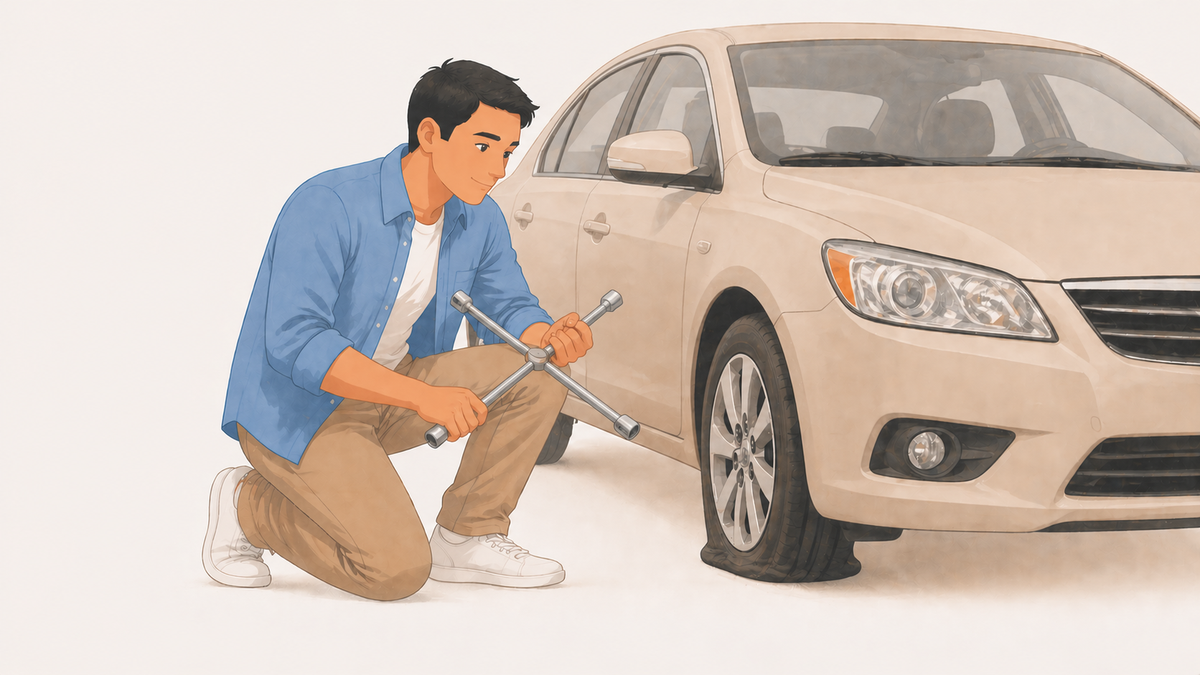
Step 1: Loosen the lug nuts before jacking the car up. With the flat tire still on the ground, put the lug wrench on each nut and turn counterclockwise. You're breaking the initial resistance, not removing them yet. The tire needs to be on the ground for this. Once the car is jacked up, the wheel spins and you can't get any leverage.
Step 2: Find the jack points. Open the owner's manual and find where the jack goes for your vehicle. The jack points are reinforced sections designed to take the car's weight. Using the wrong spot can damage the frame. It takes 30 seconds to check and is worth it every time.
Step 3: Raise the car. Jack it up until the flat tire is about six inches off the ground. No need to go higher than that.
Step 4: Remove the lug nuts and the flat. Finish removing the lug nuts and keep them somewhere they won't disappear. A pocket is fine. Pull the flat tire straight off and set it aside.
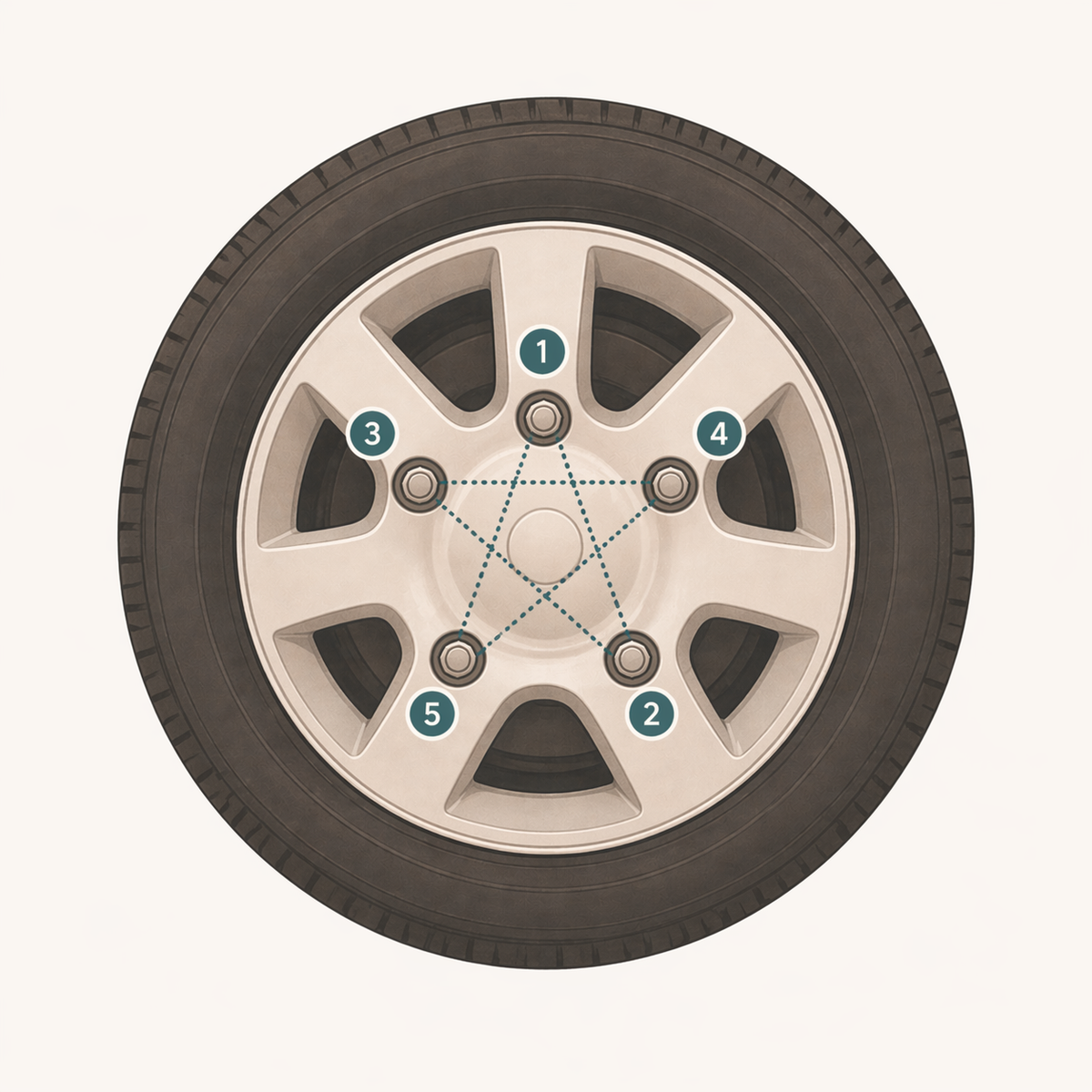
Step 5: Mount the spare. Line the holes up with the bolts and push the spare flush against the hub. Hand-tighten the lug nuts in a star pattern. Not in a circle. In a star, alternating across the wheel. This distributes pressure evenly and keeps the tire seated correctly.
Step 6: Lower the car, then fully tighten. Bring the car down to the ground before applying full force to the lug nuts. Then go around in the star pattern again, firm.
Step 7: Check the spare's pressure. Spare tires lose air over months and years of sitting in the trunk. If it looks low, drive slowly to the nearest gas station and inflate it before going further. Keep an Accutire digital gauge in the glove box so this takes 30 seconds, not a guess.
After the Change
Get to a tire shop. A donut spare has a mileage limit, usually around 50 miles, and a speed limit, usually 50 mph. Even a full-size spare should be replaced or the flat repaired as soon as you can get there.
Find out if the flat is repairable. Punctures in the tread area can often be patched cheaply. Sidewall damage means a new tire. A shop can tell you in a few minutes.
Have the lug nuts torqued properly. A torque wrench gives you a precise tightness that hand-tightening on the roadside doesn't. Worth having done the same day.
Check your spare's pressure now, while you're thinking about it. If you can't remember the last time you checked it, go do it.
When to Call Instead
There are conditions where changing the tire yourself is not the right call:
The ground is uneven or unstable. Traffic is too close. It's dark on a fast road and getting out feels dangerous. You can't locate the jack points. The spare is also flat.
In any of these situations: hazard lights on, as far off the road as possible, stay in the car, call for help. Roadside assistance exists for exactly this.
Try This
1. Practice in your driveway before you need to. Pull out the jack and spare and walk through the steps once. It takes 20 minutes and the difference between having done it once and never having done it is significant.
2. Check your spare's pressure today. It loses air slowly over time. Most people don't find out it's flat until they need it.
3. Save your roadside assistance number in your phone. AAA or your car insurance's roadside line. Have it before you need it.
4. Know whether you have a donut or a full spare. Open your trunk and look. It changes how urgently you need to get to a shop after the change.
The New Driver's Parent Checklist is a 4-page printable for parents teaching a teen to drive. Pre-drive checks, the four skill stages, and word-for-word scripts for the hard moments. Download it free →
Changing a tire is one of those skills where the only real barrier is having never done it.
Once you have, it stops being something to worry about. It becomes a problem with a known solution that you've already used. That's a different thing entirely.