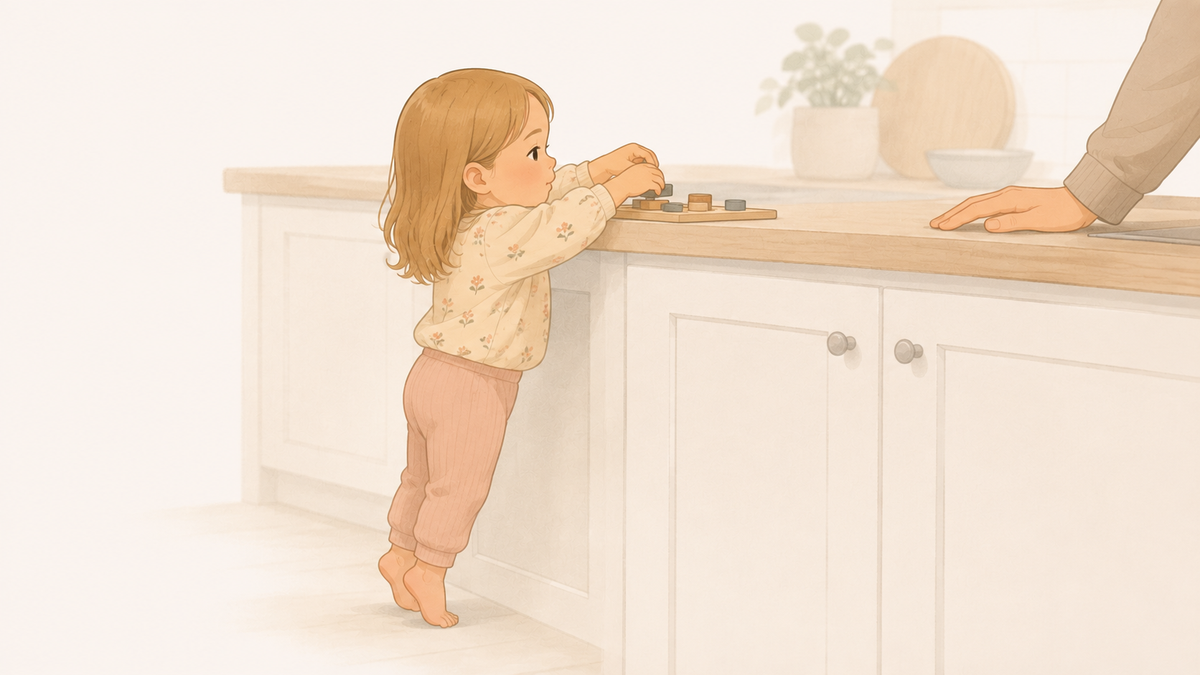
A two year old will try to do anything you are doing.
Not some things. Anything. Sweeping, wiping, carrying, pouring, buckling, unloading, closing. If you are doing it, she wants in, and the wanting is not polite.
This is the most cooperative a human being will ever be about work, and it lasts about two years, and almost all of us spend it saying not right now.
The thing I remember is looking over and realizing she was doing it too.
We don't have much space, so the living room floor is the entire world for about an hour every night, and by the end of that hour there is nowhere left to stand. I'd start picking up while she was still going, usually while she was digging around for the next thing she wanted out.
I don't know what night it changed. At some point she was just picking up alongside me, at the same time, without anybody asking her to.
Now if she wants the Princess Tent out I'll say something like we should put some of these away so you have room, and most of the time she goes straight to it. She cleans up her toys most nights. I prompt her less every month.
I never taught her any of it. I just did it in front of her for a year.
The Window Nobody Uses
Here's the strange arithmetic of it.
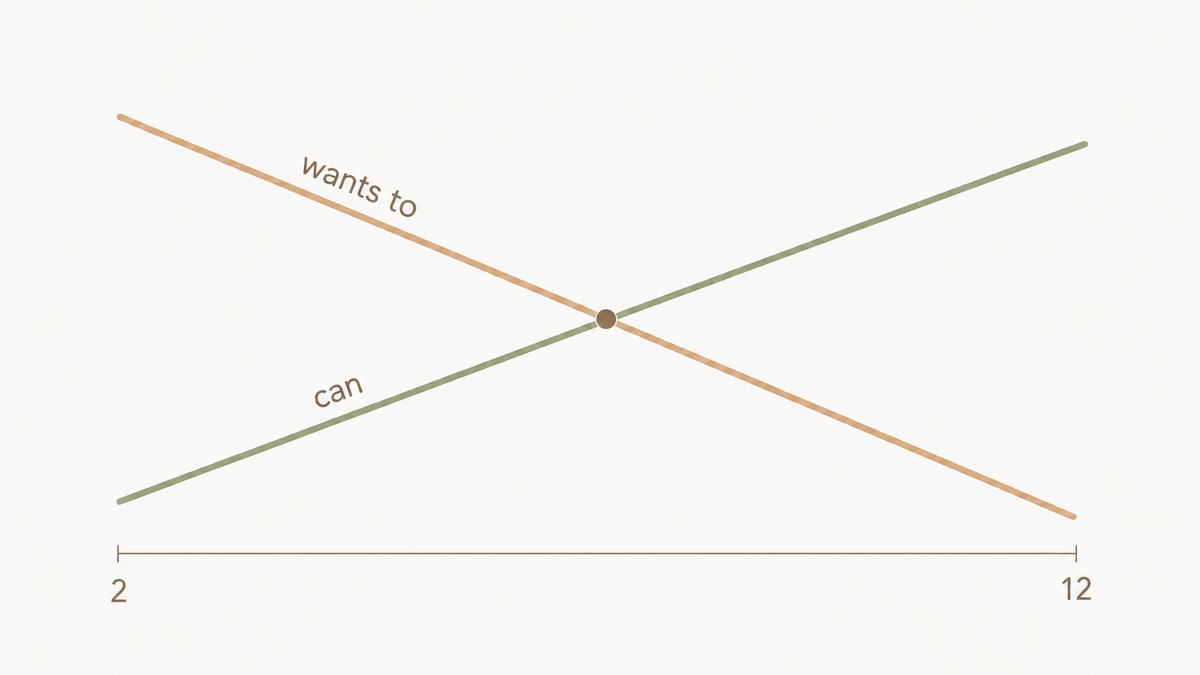
At two, a kid has maximum enthusiasm and minimum capability. At twelve, they have plenty of capability and roughly zero enthusiasm. Somewhere in the middle those lines cross, and every year after the crossing point, teaching gets harder.
We do most of our teaching after the crossing point. Because that's when it's efficient. That's when they can actually do the thing without producing a disaster.
Which means we systematically skip the part where they want to.
I don't think this is a mistake anyone makes consciously. A toddler helping is not help. It is the opposite of help, measurably, every time. You are trading twelve minutes and a clean floor for a job done badly by a person who is three feet tall.
The trade only makes sense if you're not buying the job. You're buying the habit.
What She's Actually Learning
Not sweeping. She's terrible at sweeping and will be for years.
What gets installed at two is smaller and more permanent than any specific skill:
That work is normal. Not a punishment, not a favor, not something that happens when other people aren't around. Just a thing the household does, that she's part of.
That she's the kind of person who does things. This is the one. A two year old has no self-concept yet, and it's being built right now out of what she's allowed to participate in. A kid who is always removed from the task learns she's a bystander here.
That trying is safe. She will do it wrong constantly and nothing bad will happen. That's a belief with a very long shelf life, and it's much easier to install before there's any embarrassment attached to being bad at things.
None of these need her to be competent. They only need her to be allowed.
The Cost, Honestly
I don't want to be dishonest about what this takes, because the version of this advice that skips the cost is useless.
It is slower. Every single time. Not occasionally, not on good days. Every time.
It's also loud, and it happens at the exact hours when everyone is least equipped for it, which is dinner, and getting out the door, and bedtime. Toddler help is not distributed evenly across the day. It concentrates itself precisely where you have the least slack.
My honest version isn't the one I expected it to be.
I don't say no very often when she offers. What I do instead is not offer. I'll be halfway through something before it occurs to me that I never asked whether she wanted in, and the reason I didn't ask is that I'd already run the math somewhere in the back of my head and decided it would take too long.
When I do ask, she says yes almost every time. I still don't know whether that's because she wants to learn the thing or because she wants to be standing next to me. Probably it doesn't matter.
And when she is helping, and following exactly none of the directions I'm giving her, I do get frustrated. That part is real. Most of the time the voice saying it stays in my head, which I'm choosing to count as progress.
So I've stopped trying to always say yes. What I try to do instead is notice when I'm saying no out of habit rather than out of an actual constraint. Those are different, and the second one is a lot rarer than my reflexes suggest.
What Actually Works
Not much, and it's all logistical rather than emotional.
Set it up before she gets there. Pre-measure, pre-clear, move what shouldn't be touched. The prep is mine. The task is hers. This is the difference between letting her help and supervising a hazard.
Give her the real thing, smaller. A real cloth, a real cup, a real job with a beginning and an end. Toddlers are excellent at detecting a fake job. A pretend task teaches pretend participation.
Pick the slot with slack in it. Saturday morning, not Tuesday at six. There's no rule that says the help has to happen when it's hardest.
Let it be bad and then leave it bad. Do not redo it in front of her. That's the whole lesson undone in four seconds. Fix it later or don't fix it.
Say what happened, not how she did. "The water went on the floor, so next time we fill it in the sink" beats good job, which means nothing, and beats no, which ends it.
That's the same five moves I'd use on a teenager, running at a much smaller scale, with much lower stakes and much better attendance.
The Long Game
The thing that keeps me doing this on the days I don't want to is that I've seen the other end of it.
There's a version of a kid who arrives at sixteen genuinely surprised that a household requires labor. That doesn't happen at sixteen. It's the accumulated result of about fourteen years of being removed from the task because it was faster, each removal completely reasonable on its own.
And the reverse is just as quiet. Nobody has a moment where their kid becomes capable. You just stack a few thousand small allowances, and then one day there's a person in your house who notices something needs doing and does it.
The chores by age list starts at two for exactly this reason. It looks absurd on paper. Put toys in a bin, carry a plate to the sink. It isn't a chore list at that age. It's the opening move.
Try This
1. Say yes to one thing today you'd normally say not right now to. One. Notice how long it actually took versus how long you assumed.
2. Set it up first. Ninety seconds of prep converts most toddler help from a hazard into a task.
3. Don't fix it where she can see.
4. Pick a recurring slot with slack in it, and make that the one she's always part of. It matters more that it's every week than that it's every day.
5. When she gets frustrated, wait longer than feels right. The frustration is usually the work happening, not a problem to solve.
Teach Your Kid Almost Anything is a free starter framework for raising a capable kid. A simple five-step method that works on almost any skill, plus a competence inventory to work through over the years. Download it free →
She'll stop asking eventually. Every parent I know who's further along says the same thing about the same age, and says it with a slightly odd look.
Right now she wants in on everything, including things there is no reason for her to want in on. It's exhausting and it's the cheapest teaching I will ever get offered.